
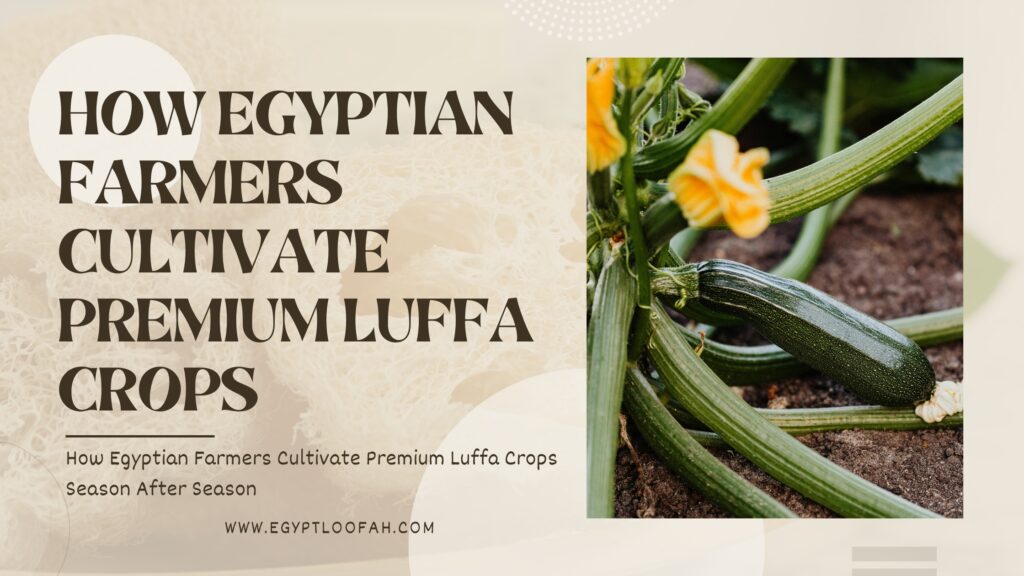
Egypt produces more natural luffa than any other country on earth. It is the direct result of Egyptian luffa farming practices that have been refined across generations of agricultural families in the Nile Valley.
This article takes you inside the full cultivation cycle. You will learn how Egyptian farmers select seed varieties, prepare their soil, manage irrigation in arid conditions, time their harvest for optimal fiber density, and process raw luffa into the finished product that reaches shelves and shipping containers worldwide. Whether you are a sourcing manager preparing a purchase order or a curious shopper who wants to know the story behind your loofah, this guide delivers the depth you need.
Their farm to export process offers a transparent window into how premium Egyptian loofah moves from field to finished goods.
The Climate and Geography Behind Egyptian Luffa Farming Practices
The Luffa aegyptiaca plant is technically a tropical gourd, but it reaches its highest fiber quality under a very specific set of environmental conditions that Egypt’s Nile Valley delivers naturally.
Why the Nile Valley Creates Ideal Growing Conditions
The primary growing regions for Egyptian luffa span the governorates of Minya, Assiut, Sohag, and Qena in the Nile Delta. These areas share several critical characteristics. Daytime temperatures consistently exceed 35 degrees Celsius during the summer growing months.
Tropical regions with high humidity often yield loofahs with looser fiber structures that feel softer initially but break down much faster during use. For importers evaluating product quality for their market, it means more customer complaints and higher return rates.
Soil Composition and Its Effect on Fiber Quality
Egyptian Nile Valley soil contains a balanced mix of clay, silt, and sand with naturally high levels of potassium and phosphorus. These nutrients directly influence the cellulose content of luffa fibers. Higher cellulose density translates to firmer, more resilient scrubbing surfaces that hold their shape under repeated wet and dry cycles. This is a selling point for eco-conscious consumers and a compliance advantage for importers shipping to markets with strict residue regulations.
To learn more about how these natural advantages translate into product quality standards, review Egexo’s quality standards documentation.
The Complete Egyptian Luffa Cultivation Cycle
EGEXO has been exporting Egyptian loofah since 2015. Each stage directly influences the quality of the finished loofah, and experienced Egyptian farmers understand the precise timing and techniques required at every phase.
Season-by-Season Cultivation Timeline
| Phase | Timing | Key Activities | Quality Impact |
|---|---|---|---|
| Seed Selection | January to February | Choose high-yield seed varieties from previous season’s best plants | Determines fiber genetics and growth potential |
| Planting | March to April | Sow seeds in rows spaced 1 to 1.5 meters apart with trellis support structures | Proper spacing prevents mold and promotes airflow |
| Flowering and Fruit Set | June to July | Monitor pollination, thin excess fruit for quality over quantity | Thinning concentrates plant energy into fewer, better loofahs |
| Maturation | August to September | Reduce irrigation gradually, allow fruit to dry on vine | Controlled drying creates the densest fiber structure |
This 8 to 10 month cycle means that Egyptian farmers commit nearly a full year to each crop. The extended timeline is one reason why Egyptian luffa commands premium positioning in global markets. Shortcuts at any stage visibly reduce the quality of the finished product.
Seed Selection and Genetic Quality
The cultivation cycle begins long before any seed touches soil. Egyptian farming families maintain their own seed banks, selecting seeds exclusively from the previous harvest’s highest-performing plants. The criteria are specific. They choose seeds from luffa fruits that measured at least 35 centimeters in length, demonstrated tight and uniform fiber weave, and showed no signs of disease or insect damage during growth.
This selective breeding approach, repeated over many generations, has produced Egyptian luffa varieties with naturally superior fiber density compared to wild or commercially distributed seed stock used in other countries. It is a form of agricultural heritage that cannot be purchased or fast-tracked. For B2B buyers, this genetic quality baseline is one of the core reasons to source from Egypt rather than newer growing regions.
Irrigation Management in Arid Conditions
Water management is one of the most skill-intensive aspects of Egyptian luffa farming practices. The Nile Valley receives almost no rainfall during the growing season, so farmers rely entirely on canal irrigation drawn from the Nile River system. The challenge is delivering enough water during vine growth while carefully reducing moisture during the maturation phase.
Over-irrigation during maturation produces luffa with high moisture content that requires aggressive artificial drying and often results in weaker fibers. Under-irrigation during vine growth stunts fruit development. This gradual approach lets the fiber tighten naturally as the fruit dries on the vine, producing the characteristic firmness that distinguishes premium Egyptian loofah.
For consumers curious about why some loofahs feel firmer and more structured than others, the answer often comes down to how well the farmer managed this drying phase. You can explore the range of finished products this process creates by browsing Egexo’s bath and body loofah collection.
Harvesting and Post-Harvest Processing That Define Quality
The harvest and processing phases are where raw agricultural product becomes a finished good ready for retail shelves or wholesale shipment. Egyptian luffa farming practices during this stage are notably more labor-intensive than methods used in other growing regions, and that extra effort shows in the final product.
How Egyptian Farmers Know When to Harvest
Timing the harvest is arguably the most critical skill in luffa cultivation. Egyptian farmers rely on three sensory indicators developed through experience. First, the outer skin of the fruit turns from green to dry brown. Second, the fruit feels lightweight relative to its size, indicating that interior moisture has evaporated. Third, shaking the fruit produces a distinct rattling sound as the dried seeds move freely inside the fiber matrix.
Harvesting too early, even by a week, yields luffa with immature fibers that collapse under pressure and discolor quickly when wet. Harvesting too late risks fiber becoming brittle and cracking during the peeling process.
The Post-Harvest Processing Steps
| Step | Process | Duration | Purpose |
|---|---|---|---|
| 1 | Peeling | Immediate after harvest | Remove dried outer skin to expose fiber network |
| 2 | Seed Removal | Same day | Shake and tap out dried seeds, save best for replanting |
| 3 | Initial Wash | Same day | Rinse fibers in clean water to remove sap and debris |
| 4 | Soaking | 24 to 48 hours | Submerge in water to soften remaining plant material |
| 5 | Scrubbing | After soaking | Hand-scrub each piece to remove any remaining inner pulp |
| 9 | Compression and Packaging | Final stage | Press, package, and prepare for storage or shipment |
Every step in this process is performed by hand in most Egyptian farming operations. Machine processing exists for high-volume operations, but hand processing generally produces a cleaner, more intact fiber structure. This manual approach is labor-intensive but results in the quality that has made Egyptian loofah the global standard.
For importers interested in how this processing translates into export-ready product, Egexo’s farm to export process page provides detailed documentation with visual references.
Egyptian Luffa Farming Practices Compared to Other Regions
Smart sourcing decisions require comparative data. The following table puts Egyptian cultivation methods side by side with practices in other major luffa-producing regions so that importers and consumers can evaluate the differences with clear metrics.
Regional Farming Comparison
| Factor | Egypt (Nile Valley) | China (Southern Provinces) | India (Various Regions) | Central America | Southeast Asia |
|---|---|---|---|---|---|
| Primary growing season | March to October | April to September | June to November | Year-round | Year-round |
| Average growing cycle | 8 to 10 months | 5 to 7 months | 5 to 7 months | 6 to 8 months | 5 to 7 months |
| Drying method | On-vine, natural sun dry | Artificial heat drying common | Mixed methods | Natural and artificial | Artificial common |
| Fiber density (1 to 10 scale) | 9 | 6 | 5 | 7 | 5 |
| Seed selection practice | Generational selective breeding | Commercial seed stock | Mixed | Commercial seed stock | Commercial seed stock |
| Post-harvest processing | Hand processing standard | Machine processing common | Mixed | Mixed | Machine processing common |
| Export infrastructure | Mature, well-documented | Advanced | Developing | Developing | Basic |
The data points to a clear pattern. Egyptian luffa farming practices involve longer growing cycles, more natural drying methods, lower chemical inputs, and more refined seed genetics. The shorter cycles and artificial drying methods common in Asian growing regions speed production but sacrifice the fiber quality that discerning markets demand.
What Egyptian Farming Quality Means for Your Business or Bathroom
The connection between farming practices and end-product performance is direct and measurable. Whether you are building a retail brand around natural personal care or simply choosing a loofah for your morning shower, the cultivation methods behind your product determine your experience.
For B2B Buyers: Supplier Evaluation Checklist
| Evaluation Criteria | What to Verify | Why It Matters |
|---|---|---|
| Farm relationships | Does the supplier own farms or have direct partnerships? | Direct farm access means quality control from seed to shipment |
| Years of operation | Minimum 10 years, ideally 20 or more | Longevity indicates reliability and refined processes |
| Processing method | Hand-processed or machine-processed? | Hand processing generally preserves better fiber structure |
| Export documentation | Phytosanitary certificates, certificates of origin, quality reports | Required for smooth customs clearance in most markets |
| Private label capability | Custom packaging, branding, and product design services | Enables higher margins through branded product lines |
| MOQ flexibility | Willing to accommodate trial orders at lower volumes | Reduces risk for first-time sourcing relationships |
| Communication quality | Response time under 48 hours with clear, detailed answers | Indicates professionalism and export experience |
Their vertical integration, from owned farmland to processing facilities to export logistics, gives them control over every variable that affects the loofah you receive. They also offer private label loofah manufacturing and custom loofah product design services that let importers build their own branded product lines using premium Egyptian source material.
To start evaluating Egexo as a supply partner, request a wholesale quotation or download their complete product catalog.
For Consumers: How to Identify Farm Quality in a Finished Loofah
You do not need to visit an Egyptian farm to evaluate whether your loofah was grown using proper cultivation practices. Several visible and tactile indicators tell the story.
A well-cultivated Egyptian loofah will have a uniform golden to tan color without dark spots or gray patches. The fiber network will feel dense and tightly woven when you compress it. When you hold it up to light, you should see a consistent mesh pattern without large holes or thin spots. It should feel firm when dry and become pliable but still structured when wet. If your loofah feels flimsy when dry or loses its shape quickly after a few uses, it was likely grown in conditions that did not allow full fiber maturation.
You can explore verified Egyptian loofah products at Egexo’s Products page.
The Sustainability Story Behind Egyptian Luffa Farming Practices
Sustainability is not a marketing label in Egyptian luffa agriculture. It is an inherent characteristic of how the crop has been grown for generations. Understanding this context helps environmentally conscious consumers make informed choices and helps importers position their products credibly in sustainability-focused markets.
Natural Resource Efficiency
Luffa cultivation in Egypt uses significantly less water per unit of output than many other agricultural crops grown in the same region. The plant’s natural drought tolerance during its maturation phase means that irrigation can be reduced or stopped entirely during the final two months of the growing cycle.
The crop also requires minimal chemical intervention. Healthy luffa vines are naturally resistant to most common pests in the Nile Valley environment. This keeps chemical residues off the finished product and out of local waterways.
A Fully Biodegradable Product Lifecycle
From planting to disposal, the Egyptian luffa lifecycle generates almost zero lasting environmental waste. The plant grows from soil, the fiber is harvested and processed with water and sunlight, and the finished product biodegrades completely within weeks of being composted after use. Vine waste and seed husks are returned to the soil as organic matter.
For consumers already committed to reducing plastic in their daily routines, Egyptian loofah represents one of the most practical swaps available. For retailers and brands, stocking biodegradable Egyptian loofah products adds genuine sustainability credentials to your catalog.
FAQ Section
Q1: What makes Egyptian luffa farming practices different from other countries?
A: Egyptian luffa farming practices stand apart because of the Nile Valley’s unique combination of sustained dry heat, nutrient-rich alluvial soil, low humidity during maturation, and generational knowledge passed down through farming families. These factors produce luffa with the highest fiber density in the world, typically rated 9 out of 10 compared to 5 to 7 for other regions.
Q4: Is Egyptian loofah farming sustainable and eco-friendly?
A: Yes. Egyptian luffa farming is inherently sustainable. Vine waste and seed husks are composted back into the soil. The entire lifecycle from planting to product disposal generates near-zero lasting environmental waste, making Egyptian loofah one of the most genuinely eco-friendly personal care products available.
Q5: What minimum order quantities should importers expect from Egyptian loofah suppliers?
A: No minimum order on standard products. Private label from 1,000 units. A standard 20-foot shipping container typically holds 3,000 to 5,000 loofah pieces depending on size and packaging configuration.
Q6: How can I tell if a loofah I purchased was properly cultivated in Egypt?
A: Look for uniform golden to tan coloring without dark spots or gray patches. The fiber should feel dense and tightly woven when compressed. Hold it up to light and check for a consistent mesh pattern without large holes. When dry it should feel firm, and when wet it should become pliable but retain its shape. Loofahs that feel flimsy when dry or collapse quickly during use were likely grown in conditions that prevented full fiber maturation. Always verify that the product specifies Egyptian origin.
Q7: Can I create a private label loofah brand using Egyptian-farmed products?
A: Absolutely. Private label manufacturing is one of the fastest-growing segments of Egyptian loofah exports. Suppliers like Egexo offer full white-label services including custom cutting, shaping, packaging design, brand labeling, and product assembly. This allows retailers, spa brands, and e-commerce businesses to sell premium Egyptian-farmed loofah under their own brand with significantly higher margins than generic resale.
Expert Insight from EGEXO
Many newer growing regions try to speed production by harvesting green fruit and drying it artificially with heat. This approach produces loofah that looks acceptable on the outside but lacks the internal fiber density that comes from natural vine drying in dry heat. This patience is not optional. When you evaluate any loofah supplier, ask about their drying method. If they cannot explain it in detail, they are probably not growing their own product. To discuss an order, request a quote from EGEXO.
Conclusion
Egyptian luffa farming practices represent the highest standard in natural loofah cultivation worldwide. The Nile Valley’s unique climate, nutrient-rich soil, and generations of farming expertise combine to produce luffa with fiber density, durability, and consistency that no other growing region matches. From careful seed selection in January through meticulous harvest timing in September and hand processing through December, every stage of the Egyptian cultivation cycle is optimized for quality over speed.
The farming practices behind the product are what make that difference real.
Key Takeaways:
- Egyptian luffa farming uses an 8 to 10 month growing cycle with natural on-vine drying that produces the densest fiber available globally, rated 9 out of 10 for density
- The Nile Valley’s dry heat, alluvial soil, and low humidity during maturation cannot be replicated in other growing regions
Ready to experience Egyptian loofah quality?
- For Wholesale Buyers: Request a quote or request samples
- Product catalog: Download our product catalog