
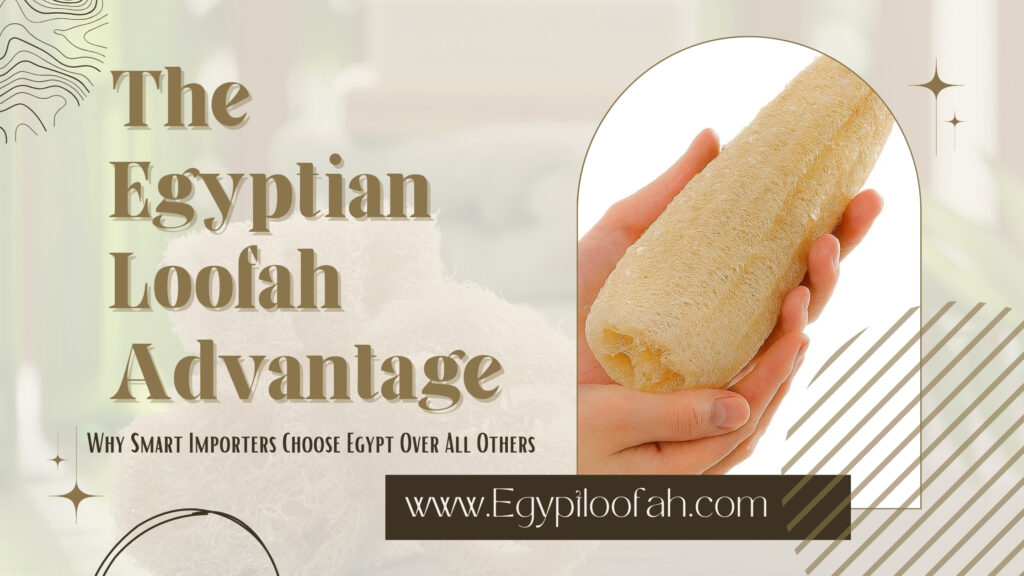
Every year, thousands of international buyers make the decision to import loofah from Egypt, and for good reason. For a sourcing manager placing a 20-foot container order or a consumer choosing a single bath sponge from an online store, the country of origin on that loofah matters more than most people realize. It determines fiber quality, durability, texture, and even how sustainably the product was grown.
The decision to source Egyptian loofah is not just about tradition or volume. EGEXO has been exporting Egyptian loofah since 2015.
This article breaks down the complete picture. You will find hard data on why Egyptian loofah outperforms alternatives, a step-by-step guide to the import process, supplier evaluation criteria for B2B buyers, practical product knowledge for consumers, and a clear look at the trends shaping this market through 2025 and into 2026.
Why Egypt Is the World’s Leading Loofah Source
The question is not whether Egypt leads the global loofah industry. The question is why Egypt leads it so decisively, and what that leadership means for anyone looking to import loofah from Egypt or buy Egyptian-origin products at retail.
Geography and Climate That Cannot Be Replicated
The Luffa aegyptiaca plant requires a specific set of growing conditions to produce dense, uniform, high-quality fiber. Egypt’s Nile Delta, spanning the Nile Delta, delivers all of these conditions naturally.
This is not something that can be easily reproduced elsewhere. Tropical growing regions in Southeast Asia or Central America often have excessive humidity during key growth phases, which weakens fiber structure and promotes mold development on the vine. Subtropical regions may lack the sustained heat required for full maturation. Egypt’s dry heat and fertile alluvial soil create a combination that produces the densest, most consistent loofah fiber available anywhere in the world.
For importers, it means fewer quality complaints and stronger product positioning in competitive markets. To explore the full range of products this environment produces, browse Egexo’s Products page for a firsthand look at Egyptian loofah quality.
A Deep-Rooted Agricultural Tradition
Egyptian loofah farming is not a recent commercial phenomenon. It is a generational practice embedded in the agricultural identity of the Nile Delta. This accumulated knowledge base means that Egyptian farmers understand the precise harvest window, the optimal retting techniques, and the sorting standards that international markets demand.
This matters to wholesale buyers because consistency is the hardest thing to achieve in natural product sourcing. When a supplier draws from a farming community with 50 or more years of collective loofah cultivation experience, the batch-to-batch variation drops dramatically. Egexo’s farm to export process is built on these relationships with experienced farming families across the Nile Delta.
How to Import Loofah from Egypt: The Complete Process
For B2B buyers considering their first or next Egyptian loofah order, understanding the import process removes uncertainty and helps you plan timelines, budgets, and logistics more effectively. For consumers and information seekers, this behind-the-scenes look reveals the care and complexity that goes into bringing a natural loofah from an Egyptian farm to your bathroom.
Step-by-Step Import Process
Repeat orders with an established supplier like Egexo move faster because specifications and logistics are already documented. You can begin the process today by requesting a quotation or ordering samples to evaluate quality firsthand.
Key Documents for Importing Egyptian Loofah
Egexo maintains all standard export documentation and can accommodate special certification requirements for EU, North American, and Asian markets.
Egyptian Loofah vs. the Competition: A Data-Driven Comparison
When you import loofah from Egypt, you are choosing a product that outperforms alternatives from every other major growing region on measurable quality criteria. The following comparison is based on industry-standard evaluation metrics used by importers, quality inspectors, and product developers worldwide.
Origin Comparison Table
| Quality Metric | Egypt | China | India | Central America | Southeast Asia |
|---|---|---|---|---|---|
| Fiber density rating | 9 out of 10 | 6 out of 10 | 5 out of 10 | 7 out of 10 | 5 out of 10 |
| Color uniformity | Excellent | Moderate | Low to moderate | Good | Low |
| Average usable length | 30 to 60 cm | 20 to 40 cm | 20 to 35 cm | 25 to 45 cm | 18 to 35 cm |
| Exfoliation consistency | Very even | Uneven | Uneven | Moderate | Uneven |
| Mold resistance (pre-sale) | High | Moderate | Low | Moderate | Low |
| Export infrastructure maturity | Advanced | Advanced | Developing | Developing | Basic |
| Private label capability | Widely available | Available | Limited | Limited | Rare |
Key takeaway: Egyptian loofah consistently leads in every quality metric that matters to both commercial buyers and end users. The fiber density advantage alone accounts for the significant durability difference, meaning fewer replacements for consumers and fewer returns for retailers.
Natural Egyptian Loofah vs. Synthetic Alternatives
| Factor | Natural Egyptian Loofah | Synthetic Loofah or Pouf |
|---|---|---|
| Material | 100 percent plant-based Luffa aegyptiaca fiber | Nylon, polyester, or plastic mesh |
| Biodegradability | Fully biodegradable in weeks | Takes 20 to 200 years to decompose |
| Exfoliation quality | Firm, even, effective dead skin removal | Inconsistent, often too soft or too rough |
| Environmental impact | Zero microplastic shedding | Sheds microplastics with every use |
| Skin feel | Natural texture improves with use | Artificial feel, static texture |
| Sustainability credentials | Renewable, compostable, carbon-neutral growth | Petroleum-derived, non-renewable |
This comparison is especially relevant for eco-conscious consumers and for retailers targeting the growing natural personal care market. If you want to explore natural options for different uses, Egexo offers dedicated categories including bath and body loofahs, kitchen loofahs, and raw loofah scrubbers.
Evaluating an Egyptian Loofah Supplier: What to Look For
Whether you are a first-time importer or a seasoned sourcing professional looking to switch suppliers, knowing how to evaluate an Egyptian loofah partner is critical. The wrong supplier can mean inconsistent quality, missed shipments, and damaged customer relationships. The right supplier becomes a competitive advantage.
Supplier Evaluation Checklist
| Criteria | What to Verify | Red Flags to Watch For |
|---|---|---|
| Years in operation | 10+ years minimum, 20+ preferred | New companies with no track record |
| Vertical integration | Farm ownership or direct farm partnerships | Brokers who buy from unknown sources |
| Export experience | Established shipping to your target region | No familiarity with your country’s import requirements |
| Sample policy | Willing to send samples before order commitment | Refuses samples or charges excessive fees |
| MOQ flexibility | Offers trial orders at lower minimums for new buyers | Rigid high minimums with no flexibility |
| Communication quality | Responds within 24 to 48 hours, clear English | Slow responses, vague answers |
| Private label capability | Can produce custom packaging and branding | Only offers generic bulk products |
| Client references | Willing to share references from existing importers | Evasive about current client base |
Egexo scores strongly across every criterion on this checklist. You can verify this yourself by reviewing their quality standards or requesting a consultation.
The Business Case: Why Import Loofah from Egypt in 2025 and Beyond
The commercial argument for Egyptian loofah sourcing has never been stronger. Several market forces are converging to make this one of the most attractive natural product categories for importers, retailers, and brand builders.
Market Drivers Fueling Demand
Government regulations are accelerating this trend. The EU Single-Use Plastics Directive, similar legislation in Canada and Australia, and growing municipal plastic bans across the United States all push consumers and retailers toward natural alternatives.
Natural loofah is one of the most accessible entry points into this market because it requires no complex reformulation, no regulatory approval beyond standard import documentation, and no consumer education about how to use it. People already know what a loofah is. They just need a better, more sustainable version of what they have been using, and Egyptian loofah delivers exactly that.
Private Label and Custom Product Opportunities
One of the strongest growth areas for importers is private label loofah products. Rather than reselling a supplier’s branded product, you create your own brand, packaging, and product line using Egyptian loofah as the raw material. This approach offers significantly higher margins and stronger customer loyalty.
Egexo is one of the few Egyptian suppliers that offers full private label loofah manufacturing and custom loofah product design services. This includes custom cutting, shaping, handle attachment, soap integration, gift set assembly, and retail-ready packaging with your branding. For importers serious about building a brand in the natural care space, this capability transforms a commodity purchase into a branded product strategy.
Expanding Product Categories
The market for Egyptian loofah extends well beyond the traditional bath sponge. Smart importers are diversifying into kitchen scrubbers, which replace plastic scouring pads. Pet and spa grooming loofahs are gaining traction with groomers and pet owners. Industrial and craft applications continue to find new niches. Each category represents an additional revenue stream from the same supply chain.
Practical Consumer Guide: Getting the Most from Egyptian Loofah
Understanding why importers choose to source from Egypt helps consumers make smarter purchasing decisions. But knowing how to use and care for your Egyptian loofah properly ensures you get the full value of that quality investment.
How to Prepare and Use Your Egyptian Loofah
When you first receive a natural Egyptian loofah, it will feel quite firm and rigid. This is a sign of quality, not a defect. Soak it in warm water for 3 to 5 minutes before your first use. The fibers will soften and become pliable while retaining their exfoliating texture. Apply your preferred body wash or soap directly onto the wet loofah, then use gentle circular motions across your skin. Start with light pressure and increase as you become accustomed to the texture.
After each use, rinse the loofah thoroughly under running water to remove all soap residue and dead skin cells. Squeeze out excess water and hang it in a well-ventilated area to dry completely between uses. This simple routine prevents bacteria buildup and extends the life of your loofah.
Maintenance and Replacement Schedule
| Timeframe | Action | Purpose |
|---|---|---|
| After every use | Rinse thoroughly, squeeze dry, hang to air dry | Prevent bacterial growth |
| Weekly | Soak in diluted vinegar solution for 5 minutes, rinse | Deep sanitize fibers |
FAQ Section
Q1: Why should I import loofah from Egypt instead of other countries?
A: The Nile Valley’s unique combination of sustained dry heat, fertile soil, and generational farming expertise creates loofah fiber that consistently outperforms alternatives from China, India, Central America, and Southeast Asia on every measurable quality metric.
Q2: What is the typical minimum order quantity to import loofah from Egypt?
A: No minimum order on standard products. Private label from 1,000 units.
Q4: What certifications should I look for when sourcing Egyptian loofah?
A: Essential certifications include a valid Egyptian export license, certificate of origin, and phytosanitary certificate for plant-based products. Experienced suppliers maintain all standard certifications and can obtain additional documentation upon request.
Q5: Can I create my own loofah brand using Egyptian-sourced products?
A: Yes. Private label manufacturing is one of the fastest-growing segments of the Egyptian loofah export industry. Leading suppliers like Egexo offer comprehensive white-label services including custom cutting and shaping, branded packaging design, label printing, product assembly, and retail-ready packaging. This allows retailers, spa brands, and e-commerce entrepreneurs to sell premium Egyptian loofah under their own brand without managing cultivation or manufacturing.
Q7: What shipping options are available when importing loofah from Egypt?
A: Egyptian loofah exporters ship primarily from the ports of Alexandria and Port Said via sea freight for full container loads and less-than-container shipments. Air freight is available for smaller, time-sensitive orders at higher cost. Prices are in USD, EX-Works Damanhour. EXW, CFR, CIF and DAP are standard. FOB and DDP only on request.
Expert Insight from EGEXO
A loofah harvested even one week too early will have underdeveloped fibers that break down quickly in use. Harvested too late, and the fiber becomes brittle, loses its natural elasticity, and cracks during processing. This is why we maintain direct relationships with farming families who have cultivated loofah for generations. Their expertise is irreplaceable, and it is the foundation of every product we ship. When you source from a vertically integrated Egyptian supplier who controls the harvest, you are buying that expertise in every fiber. To discuss an order, request a quote from EGEXO.
Conclusion
The case for choosing to import loofah from Egypt is built on measurable quality advantages, an unmatched agricultural tradition, and a mature export infrastructure that no other origin country can match.
For importers, the opportunity is clear. Rising global demand for natural, biodegradable products, combined with Egypt’s proven supply chain capabilities and private label manufacturing options, creates a strong business case for Egyptian sourcing.
Key Takeaways:
- Egyptian loofah outperforms alternatives from China, India, Central America, and Southeast Asia on fiber density, durability, and color consistency
- Private label and custom product capabilities make Egyptian sourcing a brand-building opportunity, not just a commodity purchase
Ready to experience Egyptian loofah quality?
- For Wholesale Buyers: Request a quote or request samples
- Product catalog: Download our product catalog