
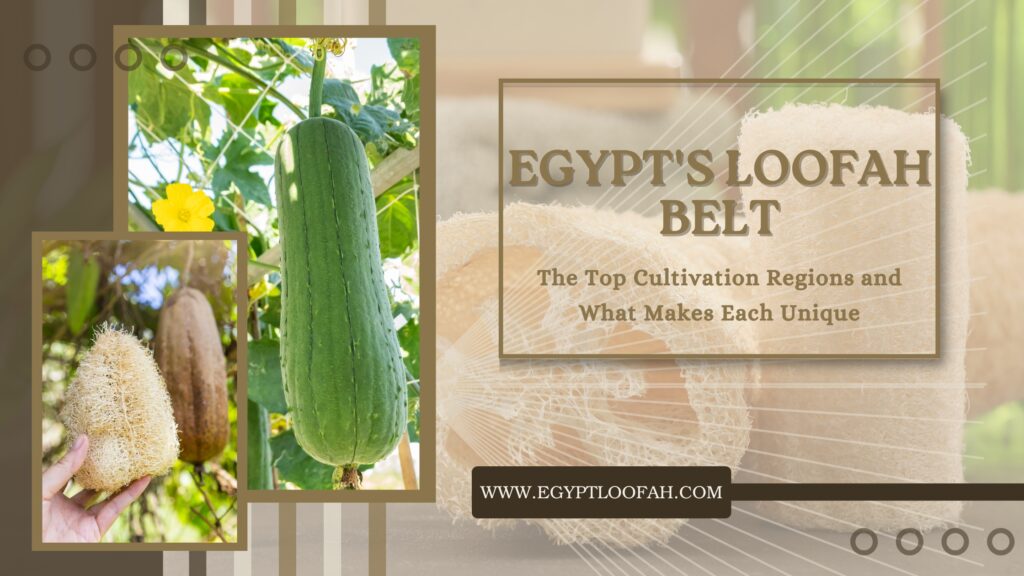
This remarkable concentration of cultivation has earned the area its nickname as Egypt’s Loofah Belt. Understanding the distinct Egypt loofah growing regions gives wholesale buyers a sourcing advantage and helps consumers appreciate why Egyptian loofahs consistently outperform alternatives from other countries.
The geography of loofah cultivation matters more than most people realize. Each region along the Nile produces loofahs with subtly different characteristics based on soil composition, microclimate variations, and generations of localized farming expertise.
This comprehensive guide maps out Egypt’s primary loofah growing regions, explains what distinguishes each area’s production, and provides practical information for evaluating region specific sourcing. Whether you are importing container loads for international distribution or simply selecting your next bath loofah, understanding Egyptian agricultural geography will inform better decisions.
EGEXO has been exporting Egyptian loofah since 2015. Their farm to export process demonstrates how regional sourcing expertise translates into consistent product quality.
Understanding Egypt’s Loofah Belt Geography
The Nile Valley Advantage
Egypt’s dominance in loofah cultivation stems from the unique conditions found in the Nile Valley. The river provides consistent irrigation in an otherwise arid landscape, while the surrounding desert creates the dry conditions necessary for optimal harvest and curing. This combination exists nowhere else on Earth at comparable scale.
The Loofah Belt stretches from the Faiyum Oasis in the north down through Middle Egypt to the Sohag Governorate in the south. Within this zone, several distinct Egypt loofah growing regions have developed specialized production profiles based on local conditions and historical cultivation practices.
The concentration of production creates infrastructure advantages including processing facilities, quality testing capabilities, and export logistics that newer producing regions cannot match.
Climate and Growing Conditions
The climate across Egypt’s loofah growing regions shares common characteristics while exhibiting meaningful variations. Summer temperatures range from 35 to 45 degrees Celsius, providing the heat necessary for vigorous vine growth.
Growing seasons begin in March with planting and extend through October for harvest. This extended season allows for careful timing of harvest based on fiber maturity rather than weather pressure. Farmers can wait for optimal maturity without risking crop loss to monsoons or hurricanes common in Asian growing regions.
The summary statement for this section: Egypt’s Loofah Belt provides ideal growing conditions through the combination of Nile Valley irrigation, desert aridity, and consistent warm temperatures that cannot be replicated elsewhere.
Major Egypt Loofah Growing Regions Compared
Faiyum Governorate
The area benefits from the Faiyum Oasis water supply fed by the Bahr Yussef canal, creating reliable irrigation independent of direct Nile access.
Loofahs from Faiyum tend toward medium density fibers with excellent flexibility. The slightly cooler temperatures compared to southern regions result in slower maturation that develops supple texture. Many manufacturers prefer Faiyum loofahs for body care products where gentle exfoliation matters most.
For wholesale buyers, Faiyum offers proximity to Cairo and Alexandria ports, reducing internal logistics costs. The region has developed strong processing infrastructure with multiple facilities capable of handling large orders. Explore body loofah options sourced from this region.
Beni Suef Governorate
The region’s fertile alluvial soil produces loofahs with uniform fiber structure and predictable characteristics. This consistency makes Beni Suef popular among B2B buyers who need reliable specifications across multiple shipments. Quality variance between batches remains minimal compared to other regions.
Beni Suef farmers have adopted modern cultivation techniques more readily than traditional growing areas. Trellising systems, drip irrigation, and systematic harvest scheduling have increased both yields and quality consistency. For buyers requiring private label manufacturing with consistent raw material supply, Beni Suef sourcing provides advantages.
Minya Governorate
This region has cultivated loofahs for over a century, developing generational expertise passed through farming families.
The soil composition in Minya includes higher mineral content that produces notably dense fiber structures. The region specializes in larger loofah sizes suitable for both whole loofah retail and cutting into multiple products.
For consumers seeking the highest quality Egyptian loofahs, Minya origin often indicates superior product. The dense fibers provide excellent exfoliation while maintaining durability through extended use. Check raw loofah scrubbers to find products from this renowned region.
Assiut Governorate
Assiut represents traditional loofah cultivation at its most established. Families in this region have grown loofahs for generations, preserving heirloom seed varieties and traditional methods alongside modern improvements.
Wholesale buyers seeking premium positioning often specify Assiut origin for marketing differentiation. The region’s reputation among industry professionals adds value to products marketed toward discerning consumers. Request information about regional sourcing through Egexo’s quotation process.
Sohag Governorate
The southernmost major growing region, Sohag produces robust loofahs known for durability and firm texture.
Hotter temperatures and longer sun exposure in Sohag develop firmer fiber structures. These characteristics make Sohag loofahs ideal for kitchen cleaning, industrial scrubbing, and applications requiring aggressive texture. The region also supplies raw material for compressed loofah products.
For B2B buyers in the kitchen and cleaning product segments, Sohag offers excellent value. The kitchen loofah category features products well suited to this regional profile.
Regional Quality Factors in Egypt Loofah Growing Regions
Soil Composition Impact
The Nile Valley’s alluvial soil varies in composition along its length, directly affecting loofah fiber development. Northern regions receive finer sediments carried longer distances, while southern areas contain coarser particles deposited closer to the Nile Delta sources.
These soil differences translate into fiber characteristics. Finer soils produce loofahs with more delicate, closely spaced fibers ideal for facial and body applications. Coarser soils develop more widely spaced, robust fibers suitable for scrubbing tasks.
Mineral content also varies by region. Areas with higher calcium content produce notably whiter loofahs after processing. Iron rich soils create loofahs with slightly warmer coloration. Neither affects performance, but color consistency matters for retail presentation.
Water Quality and Irrigation Methods
While all regions draw from Nile based water sources, irrigation methods vary significantly. Traditional flood irrigation remains common in some areas, while others have adopted drip systems that control water delivery precisely.
Drip irrigation produces more consistent loofahs because water stress remains controlled throughout the growing season. Flood irrigated fields can experience moisture variations that affect fiber development. Buyers prioritizing consistency often specify drip irrigated sources.
Water quality in the Faiyum Oasis differs from direct Nile sources due to its passage through underground aquifers. Some cultivators believe this filtered water produces cleaner, lighter colored loofahs, though scientific documentation remains limited.
Harvest Timing by Region
Harvest timing varies across Egypt loofah growing regions based on local climate conditions and market positioning strategies. Southern regions with higher temperatures mature crops earlier, typically beginning harvest in late August. Northern regions extend growing seasons into October.
Early harvest produces softer loofahs with less fully developed fiber structure. Late harvest maximizes fiber density but risks over maturation that creates brittle products. Experienced farmers in each region have developed timing expertise specific to local conditions.
For wholesale buyers, understanding regional harvest calendars helps plan procurement timing. Fresh harvest product ships from September through December, with inventory levels declining through the following summer. Request samples to evaluate seasonal quality variations.
| Quality Factor | Northern Regions | Central Regions | Southern Regions |
|---|---|---|---|
| Soil Type | Fine alluvial | Mixed composition | Coarser particles |
| Fiber Density | Medium | High | Very high |
| Fiber Flexibility | High | Medium | Lower |
| Typical Color | Light cream | Cream to tan | Tan to golden |
| Harvest Period | September to October | August to October | August to September |
| Best For | Body care, facial | Premium retail, spa | Kitchen, industrial |
Sourcing Strategies Based on Egypt Loofah Growing Regions
For Wholesale Buyers
Strategic regional sourcing can differentiate your product offerings and optimize costs. Rather than treating Egyptian loofahs as a single commodity, sophisticated buyers specify regional sources based on target market requirements.
Premium product lines benefit from Minya or Assiut sourcing where quality commands recognition. Value oriented lines perform well with Beni Suef or Faiyum product that offers consistency at competitive costs. Industrial applications find optimal value in Sohag production.
Multi region sourcing provides supply security and flexibility. Working with a supplier like Egexo who maintains relationships across all major regions protects against localized crop issues. Their quality standards ensure consistency regardless of regional source.
Consider these evaluation criteria when assessing regional sourcing options:
| Evaluation Criterion | Questions to Ask | Why It Matters |
|---|---|---|
| Regional Specialization | Which regions does the supplier source from | Indicates expertise and relationship depth |
| Supply Consistency | Can they maintain regional specifications | Confirms reliable sourcing relationships |
| Traceability | Can they document regional origin | Enables marketing claims and quality tracking |
| Flexibility | Can they blend regions if needed | Provides options for cost optimization |
For Individual Consumers
Understanding regional characteristics helps consumers select loofahs matching their preferences and needs. While most retail products do not specify regional origin, asking suppliers about sourcing can reveal quality indicators.
Consumers seeking gentle exfoliation for sensitive skin should look for northern region sourcing or products described as soft or flexible. Those wanting vigorous scrubbing power benefit from southern region products marketed as firm or durable.
The Journey from Regional Farms to Global Markets
Farm Level Production
Loofah cultivation in Egypt remains predominantly a smallholder activity. Farms averaging 2 to 5 feddans (roughly 2 to 5 acres) produce the majority of output. These family operations have cultivated loofahs for generations, developing expertise that larger commercial operations struggle to match.
The typical production cycle begins in March with soil preparation and planting. Trellising or ground cultivation systems support vine growth through summer. Harvest occurs in late summer to early fall when gourds reach full maturity and begin natural drying.
Post harvest processing at farm level includes peeling to remove outer skin, seed removal, and initial cleaning. Many farms sell at this stage to regional aggregators, though some have developed direct relationships with exporters.
Regional Aggregation and Processing
Each major growing region has developed processing infrastructure to handle local production.
The concentration of processing in established regions creates quality benchmarks that newer areas lack.
Export Preparation and Logistics
Standard products are ready in 7 to 25 days from payment. Custom time is confirmed with the quote. Sea transit time is confirmed in your quote. Major export facilities operate in Cairo, Alexandria, and regional centers with direct port access.
Documentation requirements include phytosanitary certificates, certificates of origin, and commercial documentation. Egyptian authorities have streamlined export procedures for agricultural products, reducing processing times compared to many competing origins.
The farm to export process details these stages comprehensively.
Sustainability Across Egypt Loofah Growing Regions
Environmental Practices
Egyptian loofah cultivation benefits from inherently sustainable characteristics. The crop requires minimal chemical inputs compared to industrial agriculture.
Water efficiency varies by region and irrigation method. Drip irrigated farms in Beni Suef and Faiyum achieve significantly higher water efficiency than flood irrigated operations.
The fully biodegradable nature of loofah products means that cultivation supports the replacement of plastic scrubbing products. Each hectare of Egyptian loofah production displaces an estimated 50,000 synthetic scrubbers from entering waste streams annually.
Social and Economic Impact
Loofah cultivation supports rural livelihoods across the Nile Delta, one of the country’s economically challenged regions. An estimated 30,000 to 40,000 families depend on loofah farming as their primary or secondary income source.
The labor intensive nature of harvest and processing creates employment opportunities beyond farming itself. Women play significant roles in post harvest processing, providing income opportunities in communities with limited female employment options.
For B2B buyers emphasizing social responsibility, Egyptian loofah sourcing supports meaningful development impact.
Regional Specialization for Different Product Categories
Body and Spa Applications
Premium body loofahs derive primarily from Minya and Assiut, where fiber density and quality command recognition. These regions supply raw materials for luxury spa products and premium retail brands seeking superior performance and feel.
The body loofah collection features products sourced from these premium regions. Fiber structure from central Egypt provides ideal exfoliation texture while maintaining the flexibility necessary for comfortable body care.
Spa professionals consistently prefer Egyptian body loofahs for treatment room applications. The natural variability found in loofahs from traditional growing regions appeals to wellness settings emphasizing authenticity and natural products.
Kitchen and Household Applications
Kitchen loofahs require durability and firm texture to handle scrubbing tasks. Southern region production from Sohag provides ideal characteristics for these demanding applications. The robust fiber structure withstands repeated use and aggressive scrubbing.
Kitchen applications represent a growing market segment as consumers seek plastic free alternatives for dish washing and surface cleaning. The kitchen loofah selection addresses this demand with appropriately sourced products.
Commercial foodservice operations increasingly adopt natural loofah alternatives. B2B buyers supplying restaurants and hospitality can find durable, cost effective options from southern Egyptian regions.
Pet and Specialty Applications
Pet grooming and specialty applications benefit from the range of textures available across Egypt loofah growing regions. Gentle options from Faiyum suit sensitive pet skin, while firmer Sohag products work well for thick coated breeds.
The pet and spa grooming category showcases specialty products designed for animal care applications. Regional sourcing enables texture matching for specific pet care requirements.
Custom product design services can develop specialty items leveraging specific regional characteristics for unique applications.
FAQ Section
Q1: Which Egypt loofah growing region produces the highest quality loofahs?
A: Minya and Assiut governorates in central Egypt consistently produce the highest quality loofahs due to optimal soil composition and generations of cultivation expertise. However, quality varies by intended application, and other regions excel for specific uses.
Q2: How do Egypt loofah growing regions differ from Asian production areas?
A: Egypt loofah growing regions benefit from dry climate conditions that allow natural sun drying and prevent mold issues common in humid Asian production areas. Egyptian cultivation draws from centuries of expertise, while Asian production developed more recently.
Q3: Can wholesale buyers specify regional origin when ordering?
A: Yes, experienced Egyptian suppliers can source from specific regions based on buyer requirements. Specifying regional origin helps ensure consistent product characteristics across orders. Buyers should communicate intended applications to help suppliers recommend optimal regional sourcing. Request regional specifications through wholesale quotation requests.
Q4: Does regional origin affect loofah price?
Premium regions like Minya command higher prices reflecting superior quality. Value oriented regions offer competitive pricing for standard applications.
Q5: How can consumers identify which region their loofah comes from?
A: Most retail loofahs do not specify regional origin on packaging. Consumers can ask retailers or brands about sourcing, and some premium products include origin information. Generally, lighter colored, softer loofahs likely come from northern regions, while darker, firmer products typically originate from southern Egypt loofah growing regions.
Q6: What minimum order quantities apply for region specific sourcing?
No minimum order on standard products. Private label from 1,000 units. Smaller orders may receive blended regional sourcing. Buyers requiring strict regional specifications should discuss requirements early in the quotation process.
Expert Insight from EGEXO
Knowing which farms within each governorate consistently produce superior results requires years of relationship building and quality monitoring.
Our recommendation for buyers new to Egyptian sourcing is to start with central region products from Minya or Beni Suef. These areas offer the best balance of quality and consistency while you develop understanding of the market. As your requirements become more specific, work with your supplier to identify regional sources matching particular applications.
For consumers, trust suppliers who can explain their regional sourcing rather than treating Egyptian loofahs as generic commodities. The difference between a thoughtfully sourced loofah and a random purchase becomes apparent in daily use.
Learn more about why choosing Egexo provides access to premium regional sourcing across Egypt’s Loofah Belt. To discuss an order, request a quote from EGEXO.
Conclusion
Egypt’s loofah growing regions represent a sophisticated agricultural system developed over generations of cultivation experience. From the northern oasis of Faiyum to the southern heat of Sohag, each region contributes unique characteristics to the global supply of natural loofahs.
B2B buyers can specify sourcing to match product requirements and optimize value across their product lines. Consumers can appreciate the craftsmanship and regional expertise behind quality Egyptian loofahs.
The concentration of premium loofah production in Egypt’s Nile Valley creates advantages that competing regions cannot replicate. Ideal climate, fertile soil, established infrastructure, and generational expertise combine to make Egyptian loofahs the global standard for quality.
Key Takeaways:
- Egypt’s Loofah Belt spans five major governorates, each with distinct production characteristics
- Regional sourcing enables product differentiation and quality optimization
- Understanding regional characteristics helps consumers select appropriate products
- Egyptian regional expertise represents generations of accumulated cultivation knowledge
Ready to experience Egyptian loofah quality?
- For Wholesale Buyers: Request a quote or request samples
- Product catalog: Download our product catalog