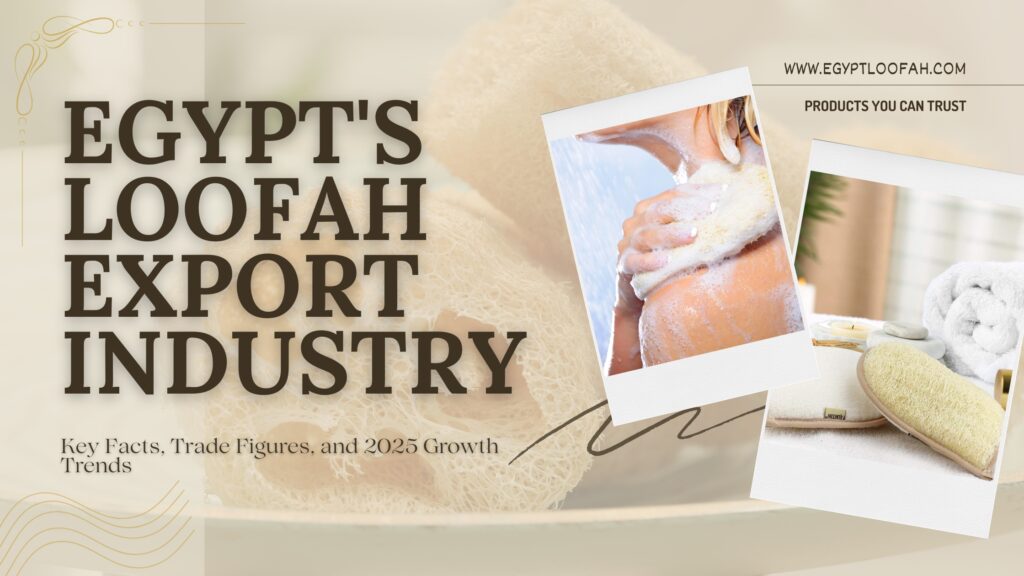
Egypt grows more natural loofahs than any other country on the planet. That single fact shapes an entire global supply chain, influences purchasing decisions for thousands of importers, and determines the quality of the loofah hanging in your shower right now.
Whether you are a sourcing manager evaluating new suppliers across North Africa, a spa owner looking for premium exfoliating products in bulk, or an individual consumer who wants to understand exactly where your loofah comes from and why Egyptian origin matters, this article delivers the numbers, context, and practical insights you need. You will find verified trade data, quality benchmarks, growth projections heading into 2025 and beyond, and actionable guidance on how to source directly from Egypt’s top loofah growing regions.
EGEXO has been exporting Egyptian loofah since 2015.
Why Egypt Dominates the Global Loofah Market
Egypt’s dominance in the loofah trade is not accidental. It results from a combination of geography, climate, agricultural tradition, and an established export infrastructure that few competitors can match.
The Climate Advantage
The Luffa aegyptiaca plant thrives in hot, dry climates with long growing seasons. Egypt’s Nile Valley, where our own farms and partner farms are, provides exactly these conditions.
Agricultural Scale and Tradition
Egyptian farmers have cultivated loofah as a commercial crop for generations. This is not a recently adopted cash crop. Families in the Nile Delta pass down cultivation knowledge, and entire villages organize their agricultural calendar around the loofah harvest cycle, which runs from late summer through autumn. This depth of expertise translates directly into consistency of output, which is exactly what wholesale buyers need when placing recurring orders.
For consumers interested in sustainability and authenticity, this heritage farming tradition also means that Egyptian loofah cultivation tends to rely on natural growing practices, minimal chemical inputs, and sun-drying methods that preserve the fiber’s integrity without industrial processing.
Egypt Loofah Export Statistics: The Numbers That Matter
The figures below are compiled from Egyptian agricultural export records, international trade databases, and industry estimates available through the end of 2024.
Export Volume and Trade Value Overview
These numbers tell a clear story. Egyptian loofah exports have grown consistently at double-digit rates, driven by rising global demand for natural, biodegradable personal care products.
For B2B buyers, this growth means that Egypt’s supply chain is scaling to meet demand, but it also means that securing a reliable supplier relationship now is critical before capacity tightens. For consumers, these numbers confirm that when you purchase an Egyptian loofah, you are buying from the world’s largest and most established source.
If you are a wholesale buyer looking to tap into this growing market, requesting a quote from Egexo is a practical first step toward understanding current pricing and availability.
Top Destination Markets for Egyptian Loofahs
However, certain markets absorb the largest share of exports.
The European Union leads in import volume largely because EU regulations increasingly favor natural, biodegradable products over synthetic alternatives. North America follows closely, with the United States representing the single largest national market for Egyptian loofah products.
For importers targeting these regions, understanding the quality standards that each market demands is essential. European buyers, for instance, often require specific certifications and documentation that experienced Egyptian exporters like Egexo routinely provide.
What Makes Egyptian Loofah Quality Superior
Numbers only tell part of the story.
Egyptian Loofah vs. Other Origins: A Quality Comparison
| Quality Factor | Egyptian Loofah | Chinese Loofah | Indian Loofah | Central American Loofah |
|---|---|---|---|---|
| Fiber density | High to very high | Medium | Medium to low | Medium |
| Color consistency | Excellent, uniform light tan | Variable | Variable | Good |
| Average usable length | 30 to 60 cm | 20 to 40 cm | 20 to 35 cm | 25 to 45 cm |
| Exfoliation effectiveness | Superior, even texture | Moderate | Moderate | Good |
| Seed cavity uniformity | Tight, small cavity | Larger cavity | Larger cavity | Medium cavity |
| Export infrastructure maturity | Advanced | Advanced | Developing | Developing |
These differences are not subjective. Fiber density, for example, can be measured by weight per unit area of the dried loofah cross-section. Egyptian loofahs consistently score higher on this metric because of the growing conditions described earlier.
For wholesale buyers, this quality advantage translates into fewer customer complaints, longer product shelf appeal, and stronger brand positioning if you are selling under your own label. Egexo offers private label loofah manufacturing specifically designed to help brands leverage Egyptian quality under their own branding.
For everyday consumers, this means a noticeably better shower experience. An Egyptian loofah provides firm but gentle exfoliation that removes dead skin cells effectively without scratching or irritating the skin, something lower-density fibers struggle to do consistently.
The Egyptian Loofah Supply Chain: From Farm to Your Door
Understanding how a loofah travels from an Egyptian farm to an international retail shelf helps both buyers and consumers appreciate the value embedded in each product. It also helps importers identify potential bottlenecks and quality control points.
The Seven Stages of Egyptian Loofah Production and Export
Stage 1: Planting and Cultivation. Seeds go into the ground between March and April in the Nile Delta. Farmers use traditional trellis systems or ground cultivation depending on the region and farm size.
Stage 2: Harvesting. Mature loofah gourds are harvested between September and November. Timing is critical. Harvesting too early produces weak fibers, while harvesting too late can result in overly rigid, brittle fibers that crack during processing.
Stage 3: Retting and Peeling. The outer skin of the gourd is removed through a water-soaking process called retting. This reveals the fibrous skeleton underneath. Seeds are shaken out and collected separately.
Stage 4: Washing and Bleaching. The raw loofah fibers undergo multiple washing cycles to remove sap, residue, and any remaining organic matter. Our standard loofah is not bleached. Bleaching is done only on request.
Stage 5: Drying and Sorting. Clean loofahs are sun-dried.
Stage 6: Processing and Packaging. Depending on the order, loofahs may be sold whole, cut into specific shapes, attached to handles, or incorporated into finished bath products. Packaging ranges from bulk bales for wholesale to individually wrapped retail-ready units.
Stage 7: Export and Shipping. Finished products are packaged according to international shipping standards and exported via Egypt’s major ports, primarily Alexandria and Port Said, to destinations worldwide.
Egexo manages this entire chain from farm to export, which gives them quality control at every stage. For buyers, this vertical integration means fewer middlemen, more consistent quality, and better pricing. For consumers, it means the product you receive has been handled with care and expertise from seed to shelf.
2025 Growth Trends Shaping Egypt’s Loofah Export Industry
Several converging trends point to continued strong growth in Egypt loofah export statistics through 2025 and beyond.
The Global Shift Away from Synthetic Products
Governments and consumers worldwide are moving away from plastic-based personal care products. The EU’s Single-Use Plastics Directive, similar legislation in Canada and parts of Asia, and growing consumer awareness of microplastic pollution all boost demand for natural alternatives like loofah sponges. Egyptian loofah, being 100 percent biodegradable and plant-based, is perfectly positioned to benefit from this shift.
Rise of Private Label and Custom Products
More retailers and e-commerce brands want to sell loofahs under their own brand name. This trend drives demand for Egyptian manufacturers who can offer custom loofah product design services, including custom shapes, sizes, packaging, and branding. Egypt’s established manufacturing base makes it the natural partner for these private label programs.
Expansion Beyond Bath and Body
While personal care remains the primary market, Egyptian loofah is gaining traction in kitchen cleaning, pet grooming, and even industrial applications. Kitchen loofahs serve as effective, eco-friendly alternatives to plastic scrub pads. Pet and spa grooming loofahs are popular with groomers and pet owners who want natural options. This market diversification adds new revenue streams for exporters and more choices for consumers.
Supplier Evaluation Checklist for Importers
Before committing to an Egyptian loofah supplier, B2B buyers should evaluate several critical factors.
| Evaluation Criteria | What to Look For | Why It Matters |
|---|---|---|
| Years of experience | 10+ years, ideally 20+ | Ensures consistent supply chain knowledge |
| Vertical integration | Farm-to-export control | Better quality control, fewer middlemen |
| Sample availability | Free or low-cost samples provided | Lets you test before committing |
| MOQ flexibility | Ability to start with smaller trial orders | Reduces risk for new relationships |
| Certifications | Relevant export and quality certifications | Required for many destination markets |
| Private label capability | Custom branding and packaging | Essential for brand builders |
| Communication responsiveness | Quick, clear responses in English | Critical for smooth international trade |
| Reference clients | Willing to provide references | Validates reliability claims |
| Shipping experience | Established logistics to your region | Reduces delivery risk and cost |
You can review their full range by viewing the Products page or downloading their product catalog directly.
How Consumers Benefit from Egypt’s Loofah Export Strength
You do not need to be an importer to care about Egypt loofah export statistics. As a consumer, these numbers directly affect the quality, availability, and affordability of the natural loofah products you buy.
Better Selection and Availability
This competition among retailers tends to keep pricing fair while maintaining high quality standards.
Sustainability You Can Trust
Egypt’s large-scale loofah farming is inherently sustainable. The plants grow with minimal water compared to many commercial crops, require little to no synthetic pesticides in traditional Egyptian cultivation, and produce a fully biodegradable end product. When the global market is strong, Egyptian farmers have more economic incentive to continue these sustainable practices rather than switching to less eco-friendly cash crops.
Practical Tips for Choosing and Using Egyptian Loofahs
To get the best value from an Egyptian loofah, soak it in warm water for 2 to 3 minutes before use to soften the fibers. Use gentle circular motions while exfoliating, rinse thoroughly after each use, and hang it in a well-ventilated area to dry completely between uses.
The Business Opportunity: Why Now Is the Time to Source Egyptian Loofah
For trade professionals and importers, the current market conditions present a compelling case for entering or expanding in the Egyptian loofah space.
Egyptian loofah supply, while expanding, still commands strong margins because of its recognized quality premium. Importers who establish relationships with reliable Egyptian suppliers now will be well-positioned as demand continues to climb.
The wholesale market for natural loofahs also benefits from high repeat purchase rates. Unlike durable goods that customers buy once, loofahs are consumable products that need regular replacement, creating predictable recurring revenue for retailers and distributors.
FAQ Section
Q1: What do Egypt loofah export statistics tell us about global market trends?
A: This growth reflects the global shift toward natural, biodegradable personal care products and expanding demand across Europe, North America, and East Asia.
Q2: What is the minimum order quantity for importing Egyptian loofahs?
A: No minimum order on standard products. Private label from 1,000 units. It is best to request a direct quote and samples to evaluate quality before committing to volume. You can request samples and pricing through the Egexo quotation page.
Q4: Are Egyptian loofahs sustainable and eco-friendly?
A: Yes. Egyptian loofahs are 100 percent natural, plant-based, and fully biodegradable. Traditional cultivation in Egypt’s Upper Nile region uses minimal synthetic inputs, and the sun-drying process requires no fossil fuel energy. The entire product decomposes naturally after disposal, making it one of the most sustainable alternatives to plastic bath sponges and synthetic scrubbers available today.
Q5: What certifications should importers look for when sourcing Egyptian loofahs?
A: Importers should verify that suppliers hold relevant export licenses issued by Egyptian trade authorities, along with any certifications required by the destination market. EGEXO’s management system is certified to ISO 9001:2015, ISO 14001:2015 and ISO 45001:2018. Its good manufacturing practices are certified to ISO 22716:2007. We also hold a Certificate of Origin or EUR.1, a Phytosanitary Certificate and an Export License.
Q6: Can I get Egyptian loofahs with my own brand and packaging?
A: Yes. Private label manufacturing is one of the fastest-growing segments of Egypt’s loofah export industry. Leading suppliers offer custom branding, packaging design, labeling, and product configuration services. This allows retailers, spa brands, and e-commerce sellers to sell premium Egyptian loofahs under their own brand name without managing the manufacturing process themselves.
Q7: What is the difference between raw and processed Egyptian loofahs?
A: Raw Egyptian loofahs are whole, dried loofah fibers sold in their natural cylindrical shape after cleaning and sorting. Processed loofahs have been cut, shaped, or combined with other materials such as handles, strings, or soap to create ready-to-use bath and body products. Both types originate from the same high-quality fiber, but processed products command higher retail value and appeal to different buyer segments.
Expert Insight from EGEXO
One insight we consistently share with new importers is this: the single most important factor in loofah quality is not the processing or packaging. It is the growing conditions and harvest timing. A loofah harvested at the right moment from well-maintained Egyptian farmland will always outperform a loofah from any other origin, regardless of how it is processed afterward. That is why vertical integration from farm to export is not just a business model for us. It is the foundation of everything we deliver. When you source from a supplier who controls the entire chain, you get traceability, consistency, and the confidence that every shipment meets the same high standard. To discuss an order, request a quote from EGEXO.
Conclusion
For importers and wholesale buyers, this represents both an opportunity and a call to action. Securing a reliable Egyptian supply partner now ensures you can meet rising consumer demand for natural, sustainable personal care products with the highest quality loofah available globally. For consumers, understanding these trade dynamics helps you make informed purchasing decisions and appreciate the craft and care behind every Egyptian loofah product you use.
Key Takeaways:
- The global shift away from synthetic, plastic-based products is the primary growth driver heading into 2025
- Vertical integration from farm to export, as practiced by Egexo, delivers the best quality control and pricing for buyers
Ready to experience Egyptian loofah quality?
- For Wholesale Buyers: Request a quote or request samples
- Product catalog: Download our product catalog