
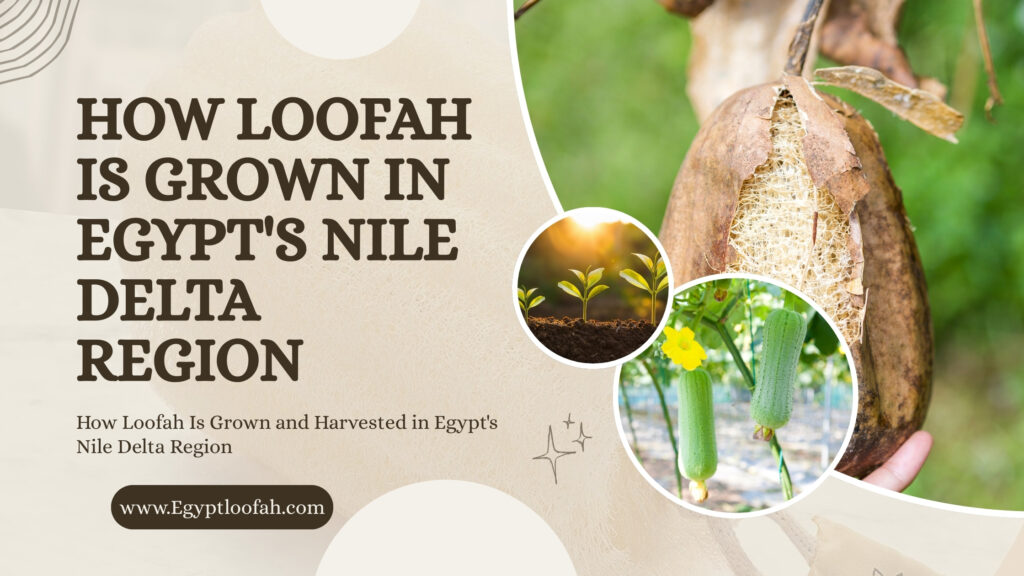
The Ancient Farming Tradition Behind Every Egyptian Loofah
The Nile Delta, stretching across the northern lowlands between Cairo and the Mediterranean coast, has been the heartland of loofah farming for centuries. The combination of nutrient-rich alluvial soil, warm subtropical climate, and generations of agricultural expertise makes this area uniquely suited for cultivating Luffa aegyptiaca, the botanical species behind the loofah sponge you use in the bath or sell in your retail store.
Understanding loofah farming in Egypt’s Nile Delta matters whether you are a sourcing manager evaluating a new supplier, a spa owner looking for premium natural products, or an eco-conscious consumer who wants to know the story behind what you buy. The origin of a loofah determines its fiber density, durability, texture, and overall quality. Egyptian-grown loofahs consistently rank at the top of international quality assessments, and the farming practices in the Nile Delta are the primary reason.
In this guide, you will learn exactly how Egyptian farmers plant, cultivate, harvest, and process loofah sponges. Whether you plan to request a wholesale quote or simply want to shop for the best bath loofah for your home, the knowledge starts here.
Why the Nile Delta Is the World’s Premier Loofah Growing Region
The Nile Delta is not just another agricultural zone. It is a uniquely productive ecosystem shaped by thousands of years of seasonal flooding, mineral deposition, and careful land stewardship. For loofah farming, these conditions translate into measurable advantages that no other growing region can fully replicate.
Soil Composition and Nutrient Profile
The alluvial soil of the Nile Delta contains high concentrations of nitrogen, potassium, and phosphorus, the three primary nutrients that drive vigorous vine growth and fiber development in luffa plants.
Climate Conditions for Optimal Growth
Luffa aegyptiaca thrives in sustained heat with moderate humidity. That extra time on the vine directly contributes to tighter fiber weave and greater sponge resilience.
Generational Farming Knowledge
Many loofah farming families in the Delta have cultivated this crop for three or more generations. This accumulated expertise covers everything from optimal planting density to irrigation timing to hand-selection during harvest. EGEXO has been exporting Egyptian loofah since 2015. You can explore their complete farm to export process to see how this partnership works in practice.
The Complete Loofah Farming Cycle in Egypt
Understanding the full cultivation cycle helps buyers evaluate product quality and helps consumers appreciate what goes into a truly premium natural sponge.
Stage 1: Seed Selection and Soil Preparation (February to March)
The farming cycle begins in late winter. Experienced growers select seeds from the previous season’s best-performing gourds, choosing only those with the densest and most uniform fiber patterns. Proper seed selection is the single most important factor in determining final sponge quality, and top-tier suppliers like Egexo maintain strict seed stock protocols.
Stage 2: Planting and Early Growth (March to April)
Seeds go into the ground when soil temperatures consistently reach 20 degrees Celsius, typically in mid-March. Planting follows a spacing pattern of approximately 1.5 to 2 meters between plants to allow adequate vine spread and air circulation. Farmers install trellising systems made from bamboo or metal wire to support the climbing vines, which can reach lengths of 8 to 10 meters at full maturity.
Stage 3: Vine Training and Flowering (May to June)
As vines grow, farmers train them along the trellis structures, pruning excess lateral shoots to direct energy toward fruit production. Yellow flowers appear in late May, and pollination occurs naturally through local bee populations. Each healthy vine typically produces between 15 and 25 loofah gourds over the growing season. This stage also involves careful irrigation management, as overwatering can lead to root rot while underwatering weakens fiber development.
Stage 4: Gourd Development and Maturation (July to September)
This is the critical period where fiber structure forms inside the developing gourds. A mature loofah gourd measures between 30 and 60 centimeters in length and 8 to 12 centimeters in diameter, depending on the variety. The extended Nile Delta growing season allows gourds to stay on the vine until fiber maturation is complete, a luxury that shorter-season regions do not have.
Stage 5: Harvest and Initial Processing (October to November)
Harvest begins when the gourd skin turns brown and dry and the interior fibers harden. Farmers hand-pick each gourd, a process that ensures only fully mature sponges are collected. After picking, the outer skin is peeled away, seeds are shaken out and saved for the next planting, and the raw loofah sponges are washed in clean water.
From Farm to Finished Product: The Manufacturing Chain
The journey from raw harvested gourd to finished bath sponge, kitchen scrubber, or spa accessory involves several processing stages. Understanding this chain matters for importers who need consistent supply and for consumers who want assurance that their product is genuinely natural and responsibly made.
Cleaning and Bleaching
After initial washing at the farm level, raw loofah sponges undergo a secondary cleaning process at manufacturing facilities. Our standard loofah is not bleached. Bleaching is done only on request. This is a critical distinction for buyers in markets with strict cosmetic safety regulations such as the EU and Japan.
Cutting, Shaping, and Product Assembly
Once cleaned, loofah sponges are cut and shaped into various product formats. These include whole body sponges, sliced rounds, back scrubbers, kitchen pads, pet grooming tools, and dozens of other configurations. Egexo offers custom loofah product design services for brands that need unique shapes, sizes, or combinations with other materials like cotton and wooden parts.
Quality Control Before Export
Every batch undergoes final quality control inspection. This includes checking for consistent sizing within tolerance ranges, verifying fiber integrity, confirming color uniformity, and testing elasticity. EGEXO’s management system is certified to ISO 9001:2015, ISO 14001:2015 and ISO 45001:2018. Its good manufacturing practices are certified to ISO 22716:2007. We also hold a Certificate of Origin or EUR.1, a Phytosanitary Certificate and an Export License.
Quality Control Checklist for Loofah Buyers
| Checkpoint | What to Verify | Why It Matters |
|---|---|---|
| Fiber Uniformity | Consistent density across the entire sponge | Ensures even exfoliation and professional appearance |
| Structural Strength | No tears, thin spots, or crumbling sections | Determines product durability and customer satisfaction |
| Odor Test | Clean, neutral scent with no musty or chemical smell | Indicates proper drying and safe chemical processing |
| Size Tolerance | Within plus or minus 1 cm of stated dimensions | Critical for retail packaging and private label specifications |
| Elasticity Test | Springs back when compressed | Confirms fiber vitality and adequate maturation |
For wholesale buyers, requesting samples before placing a large order allows you to verify each of these checkpoints firsthand.
Sourcing Egyptian Loofah: What Importers Need to Know
If you are a distributor, retailer, spa owner, or brand looking to source loofah from Egypt’s Nile Delta, the process involves several considerations beyond just product quality. No minimum order on standard products. Private label from 1,000 units.
Minimum Order Quantities and Lead Times
Standard products are ready in 7 to 25 days from payment. Custom time is confirmed with the quote. Sea transit time is confirmed in your quote. You can get exact figures by requesting a quotation directly.
Export Documentation and Certifications
Egyptian loofah exports require a standard set of trade documents including a certificate of origin, phytosanitary certificate, commercial invoice, and packing list. Reputable suppliers handle all documentation as part of their service.
Supplier Evaluation Criteria
Not all Egyptian loofah suppliers operate at the same level. Evaluating a potential supplier thoroughly protects your investment and your brand reputation. Here are the factors that matter most.
Supplier Evaluation Checklist
| Evaluation Factor | Questions to Ask | Red Flags to Watch |
|---|---|---|
| Farming Relationship | Do they work directly with Delta farmers or buy from middlemen? | Cannot identify specific farming regions or partners |
| Export Experience | How many years have they been exporting? Which markets do they serve? | Less than 3 years of export history, limited market reach |
| Sample Availability | Will they send samples before bulk order commitment? | Refuses to provide samples or charges excessive fees |
| Customization | Can they produce private label or custom products? | Only offers generic, one-size products |
| Communication | Response time, language capability, technical knowledge | Slow responses, vague answers, limited product knowledge |
| References | Can they provide references from existing international clients? | No verifiable client references |
Their complete product catalog provides detailed specifications for their full range.
Egyptian Loofah vs. Other Origins: A Comparison for Buyers and Consumers
Loofah sponges are grown in several tropical and subtropical regions worldwide. However, origin significantly impacts quality, consistency, and value. Here is how Egyptian Nile Delta loofah compares to other major sources.
Loofah Origin Comparison
| Factor | Egypt (Nile Delta) | China | India | Central America |
|---|---|---|---|---|
| Average Fiber Density | Very High | Medium | Medium to High | Medium |
| Color Consistency | Excellent | Variable | Good | Variable |
| Export Infrastructure | Well established | Well established | Developing | Limited |
| Traceability | High | Low to Medium | Low to Medium | Low |
For consumers, the takeaway is straightforward. For B2B buyers, Egyptian origin means fewer quality complaints from customers, stronger brand positioning around premium and natural sourcing, and more reliable supply consistency.
Sustainability and Environmental Practices in Nile Delta Loofah Farming
Sustainability is not just a marketing buzzword in loofah farming. It is a fundamental characteristic of the crop itself. Luffa aegyptiaca is one of the most environmentally friendly commercial crops grown in the Nile Delta, and understanding this matters to both conscious consumers and brands building eco-friendly product lines.
Water Efficiency
Loofah vines are remarkably water-efficient compared to other commercial crops grown in the same region.
Zero-Waste Crop Cycle
Almost nothing from the loofah harvest goes to waste. The fibrous sponge becomes the primary product. Seeds are saved for replanting or pressed for loofah seed oil, which has emerging applications in cosmetics. Vine material and gourd skins are composted back into the soil. Even irregular or damaged sponges find use in industrial cleaning applications, pet grooming products, or kitchen scrubbers.
Biodegradability Advantage
For consumers actively reducing their plastic footprint, switching to an Egyptian loofah is one of the simplest and most effective changes available in the personal care category.
FAQ Section
Q2: What is the minimum order quantity for importing Egyptian loofah in bulk?
A: Custom branded or private label orders may have higher minimums depending on packaging complexity. Contact Egexo for a detailed quotation based on your specific requirements.
Q4: Is Egyptian loofah farming environmentally sustainable?
A: Yes. Loofah is one of the most sustainable commercial crops in the Nile Delta. The sponge, seeds, vines, and skins all have productive uses.
Q6: Can I get custom branded or private label loofah products from Egypt?
A: Yes. Leading Egyptian suppliers offer full private label and custom product design services. This includes custom shapes, sizes, packaging, branding, and combination products that pair loofah with materials like cotton and wooden parts. Egexo provides both private label manufacturing and custom product design services for brands and retailers worldwide.
Q7: When is the best time of year to place a bulk loofah order from Egypt?
A: The Egyptian loofah harvest occurs from October through November, with processed product available for export from December onward. Placing orders between November and January ensures access to the freshest stock from the current harvest. However, established suppliers maintain inventory year-round.
Q8: How can I tell if a loofah sponge I buy online is genuinely Egyptian?
A: Genuine Egyptian loofah has distinct characteristics. Look for tight, uniform fiber density with consistent light tan coloring and a firm yet flexible texture. The sponge should spring back when compressed and have no chemical odor. Reputable sellers will state the country of origin clearly. Purchasing from verified Egyptian suppliers like Egexo guarantees authentic Nile Delta origin.
Expert Insight from EGEXO
The single biggest factor is harvest timing. A loofah gourd picked even one week too early will have underdeveloped fibers that break down quickly in use. Our farming partners use a combination of visual cues, such as skin color and dryness, and physical tests, like tapping the gourd to listen for fiber separation from the shell, to determine the precise day each gourd is ready. This attention to harvest timing is something that cannot be replicated through industrial farming methods. It requires experienced hands and patient judgment. To discuss an order, request a quote from EGEXO.
Conclusion
The region’s unmatched combination of rich alluvial soil, a long subtropical growing season, and deeply rooted farming expertise produces loofah sponges that outperform every other origin on fiber density, durability, and consistency. From the careful seed selection in February to the hand-harvested gourds in October, every stage of the Egyptian loofah farming cycle is designed to maximize quality.
For consumers, choosing Egyptian loofah means a longer-lasting, more effective, and fully biodegradable alternative to synthetic scrubbers. The origin story matters, and Egyptian loofah tells the best story in the industry.
Key Takeaways:
- The complete farming cycle spans February to January, with harvest in October and November yielding the freshest and highest quality sponges.
- Sustainable farming practices make Egyptian loofah one of the most eco-friendly personal care products available.
Ready to experience Egyptian loofah quality?
- For Wholesale Buyers: Request a quote or request samples
- Product catalog: Download our product catalog