
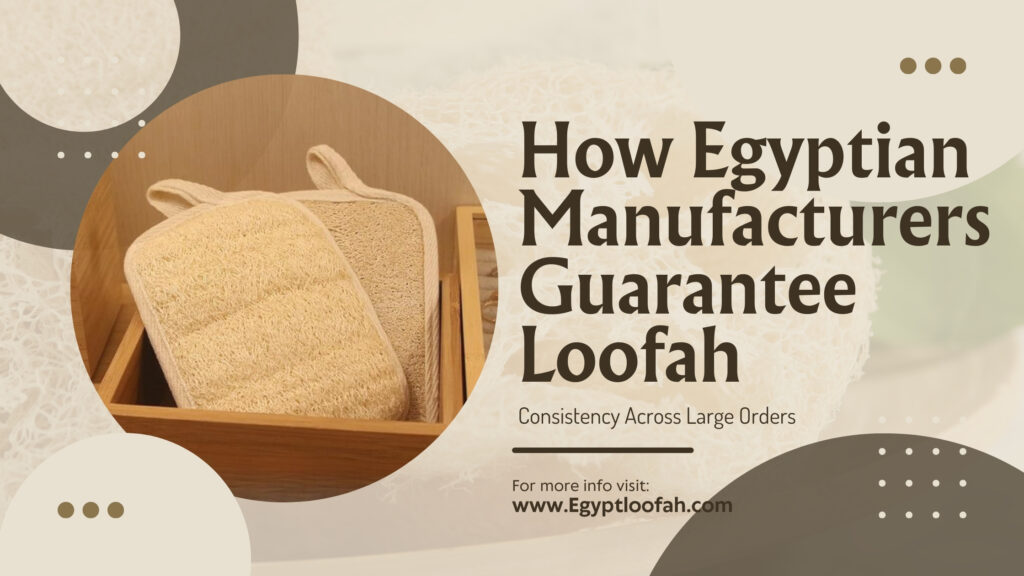
A single container of Egyptian loofah can hold anywhere from 10,000 to 50,000 individual pieces, and every one of those pieces needs to look, feel, and perform the same way. That is the challenge at the heart of Egyptian loofah quality control manufacturing, and it is the reason this topic matters whether you are importing a full shipment or picking up a single loofah at your local shop.
For B2B buyers, distributors, and sourcing managers, understanding these quality control systems is essential for evaluating suppliers, negotiating confidently, and protecting your brand reputation. For consumers and eco-conscious shoppers, knowing what happens behind the scenes helps you recognize genuinely premium products and understand why one loofah might outperform another that looks identical on the shelf.
EGEXO has been exporting Egyptian loofah since 2015.
If you are ready to evaluate quality firsthand, you can request loofah samples from Egexo at any time.
Why Egyptian Loofah Quality Control Manufacturing Matters More Than Ever
As more brands, retailers, and consumers shift away from synthetic sponges and plastic-based products, the pressure on Egyptian manufacturers to deliver consistent quality at higher volumes has intensified significantly.
The Cost of Inconsistency for Buyers and Consumers
For importers and wholesale buyers, inconsistency in a loofah shipment translates directly into financial loss. Pieces that vary widely in fiber density, color, shape, or size cannot be sold under a single SKU without generating customer complaints and returns.
Consumers experience inconsistency differently but just as concretely. If you purchase a natural loofah that feels perfect and then buy the same product again only to find it rougher, thinner, or less durable, your trust in that product and brand erodes. This is why the manufacturers behind the scenes matter so much. The systems they use determine whether the product you love today is the same product you receive six months from now.
What Sets Egyptian Manufacturing Apart
Egypt’s dominance in the loofah market is not accidental. The Nile Delta and the Nile Delta regions provide ideal growing conditions, including rich alluvial soil, consistent sunlight, and a long growing season that runs from April through October. But raw material advantage alone does not guarantee finished product quality. What distinguishes top Egyptian manufacturers is the layered quality control infrastructure they apply at every stage from field to shipment.
The Six Stages of Egyptian Loofah Quality Control Manufacturing
Understanding how quality is built into every loofah requires walking through the manufacturing process from beginning to end. Each stage introduces specific checkpoints that collectively guarantee the consistency buyers and consumers depend on.
Stage 1: Agricultural Selection and Harvest Timing
Quality control begins in the field, not the factory. Egyptian loofah farmers evaluate plants throughout the growing season, selecting gourds that reach full maturity before harvest. Harvesting too early produces soft, underdeveloped fibers. Harvesting too late can result in brittle or discolored material.
Experienced cultivators look for specific indicators of readiness. The gourd shell should feel light and dry, the interior fibers should spring back when compressed, and the seeds should rattle freely inside the dried shell. Egexo manages its own farming operations, which means agricultural quality decisions remain under direct control rather than being left to third-party growers with varying standards.
Stage 2: Post-Harvest Processing and Cleaning
Once harvested, raw loofah gourds undergo several processing steps.
Post-Harvest Processing Steps
| Step | Process | Quality Impact | Consumer Benefit |
|---|---|---|---|
| 1 | Shell removal and peeling | Exposes clean fiber structure | Smoother initial texture on skin |
| 2 | Seed extraction | Prevents mold and decay | Longer shelf life, no unpleasant odor |
| 3 | Water washing and soaking | Removes soil, debris, and tannins | Cleaner product ready for immediate use |
| 5 | Initial shape sorting | Groups gourds by natural form | Consistent appearance within product lines |
For consumers, these early steps are invisible but directly affect the loofah you eventually hold in your hand. A properly cleaned and dried loofah will feel fresh, have no residual smell, and maintain its integrity for months.
How Manufacturers Maintain Consistency Within a Single Order
Dimensional Accuracy and Size Control
Natural loofah gourds grow in varying lengths and diameters, so achieving consistent product dimensions requires careful selection and precision cutting. Top Egyptian manufacturers use templates and cutting guides to produce pieces within tight dimensional tolerances.
Standard Product Dimension Ranges
| Product Type | Typical Length | Typical Width/Diameter | Thickness | Dimensional Tolerance |
|---|---|---|---|---|
| Full body loofah sponge | 15 to 25 cm | 8 to 12 cm | Natural round | Plus or minus 1 cm |
| Loofah pad or disc | 8 to 12 cm | 8 to 12 cm | 2 to 4 cm | Plus or minus 0.5 cm |
| Kitchen loofah scrubber | 10 to 15 cm | 7 to 10 cm | 2 to 3 cm | Plus or minus 0.5 cm |
| Raw loofah tube (uncut) | 30 to 60 cm | 7 to 12 cm | Natural round | Plus or minus 2 cm |
| Custom shaped pieces | Per buyer specification | Per buyer specification | Per buyer specification | Agreed during custom product design |
These tolerances matter for B2B buyers because they determine how products fit into packaging, display on retail shelves, and meet consumer expectations. Products that vary widely in size within a single order create merchandising headaches and undermine brand credibility.
For consumers, dimensional consistency means the loofah pad you order online matches the product shown in photos. It means the replacement you buy three months later fits the same holder or dispenser. These details seem small, but they define the difference between a trustworthy product and one that feels unreliable.
Batch Tracking and Documentation
Professional Egyptian manufacturers assign batch numbers to every production run. This traceability allows buyers to report specific quality issues and have them resolved quickly.
Phytosanitary certificates, certificates of origin, and quality inspection reports can all be traced back to specific batches. Buyers who need detailed compliance documentation for regulated markets will find this infrastructure indispensable. More details on this process are available on Egexo’s farm-to-export process page.
Quality Control Checklist for Evaluating Egyptian Loofah Suppliers
Whether you are sourcing loofah for a retail brand or simply evaluating what to expect from a quality product, this checklist provides a clear framework for assessment.
Supplier Evaluation Checklist
| Evaluation Criteria | What to Look For | Why It Matters |
|---|---|---|
| Vertical integration | Supplier controls farming, processing, and export | Reduces quality variability between stages |
| Batch traceability | Unique batch numbers linked to farm origin and production date | Enables rapid issue resolution and compliance |
| MOQ flexibility | Offers trial orders alongside full container volumes | Allows you to test before scaling |
| Private label capability | In-house design, cutting, shaping, and packaging | Eliminates third-party dependencies and delays |
| Export documentation | Phytosanitary certificates, certificates of origin, packing lists | Required for customs clearance in most markets |
| Communication responsiveness | Replies within 24 to 48 hours with specific, detailed answers | Indicates operational professionalism |
| Years of operation | Minimum 10 years in loofah manufacturing and export | Demonstrates sustained reliability |
Their vertically integrated operation, documented quality framework, and responsiveness to international buyers have made them the preferred partner for importers across Europe, North America, and Asia. Learn more about why experienced buyers choose Egexo as their primary loofah supplier.
For consumers, this checklist translates into simpler terms. Brands sourced through suppliers like Egexo consistently deliver on their promises because the manufacturing infrastructure behind them is built for consistency.
Comparing Quality-Controlled Egyptian Loofah to Alternatives
Not all natural loofahs are equal, and the differences become especially clear when you compare quality-controlled Egyptian manufacturing to production from other origins or to synthetic alternatives.
Natural Egyptian Loofah vs. Other Origins vs. Synthetic Sponges
| Factor | Egyptian Loofah (Quality Controlled) | Other Origin Natural Loofah | Synthetic Sponge |
|---|---|---|---|
| Fiber density | Highest globally, tight and uniform | Variable, often less dense | Artificially uniform |
| Exfoliation effectiveness | Superior, multi-textured natural fiber | Good but less predictable | Surface-level only |
| Microplastic release | Zero | Zero | Releases microplastics with every use |
| Suitability for private labeling | Excellent, supports custom shapes and branding | Limited, less reliable for consistent branded product | Good for mass production, poor for premium positioning |
| Environmental footprint | Low, sustainable farming practices | Varies by origin | High, petroleum-based manufacturing |
This comparison highlights why Egyptian loofah, particularly from manufacturers with robust quality control, occupies the premium tier of the natural sponge market. For wholesale buyers building product lines around sustainability and quality, no other material offers the same combination of performance, consistency, and environmental credibility. For consumers looking to make genuinely eco-friendly choices, the data speaks clearly.
You can explore the full range of quality-controlled Egyptian loofah products in the Egexo Products page, from raw loofah scrubbers for craft and DIY projects to finished pet and spa grooming loofahs ready for retail.
The Role of Private Labeling in Maintaining Brand-Level Quality
For B2B buyers who sell under their own brand, quality control extends beyond the raw loofah itself into packaging, labeling, and product presentation. This is where private label loofah manufacturing becomes a critical service.
How Private Labeling Enhances Quality Consistency
When a manufacturer handles both the loofah processing and the private label packaging under one roof, the entire chain of custody stays unified. There is no handoff between a loofah processor and a separate packaging facility where different standards might apply. Egexo’s integrated private label service ensures that the same quality benchmarks governing the loofah itself also govern how it is wrapped, labeled, and prepared for shelf display.
This matters for buyers because consumer perception of quality begins with packaging. Conversely, consistent packaging that reflects the natural premium quality inside builds brand trust and supports higher retail positioning.
For consumers, this integration means that when you purchase a branded Egyptian loofah product sourced through a manufacturer like Egexo, the quality you see on the outside genuinely reflects the quality on the inside. The entire product, from fiber to label, has passed through the same quality control system.
Buyers interested in developing their own branded loofah line can explore custom product design services to create unique products tailored to their target market. Those looking for a broader overview of available formats and configurations can download the complete Egexo product catalog.
Practical Quality Tips for Consumers and Small Buyers
You do not need to be a professional importer to benefit from understanding Egyptian loofah quality control manufacturing. Here are practical ways to apply this knowledge in everyday purchasing and product care.
How to Evaluate Loofah Quality at Home
When you receive a natural Egyptian loofah, whether from a retail store or an online order, you can assess its quality in a few simple steps. First, examine the fiber structure. A well-made loofah will have an even, interconnected network of fibers without large gaps or holes. Second, press it firmly. The fibers should compress and bounce back rather than staying flat or crumbling. Third, check the color.
Maintenance That Preserves Manufactured Quality
Rinse thoroughly after every use to remove soap residue and dead skin cells. Hang in a well-ventilated space to dry completely between uses. Avoid leaving it sitting in standing water, as this accelerates fiber breakdown and bacterial growth. Deep clean once a week by soaking in a diluted vinegar solution for 10 to 15 minutes.
Buyers looking for detailed kitchen loofah options will find products specifically manufactured for the demands of dish scrubbing and kitchen cleaning.
FAQ Section
Q1: What does Egyptian loofah quality control manufacturing involve?
A: This systematic approach ensures that every piece in a large order meets the same specifications.
Q2: How can B2B buyers verify quality before placing a large loofah order?
A: Reputable suppliers like Egexo provide samples so buyers can physically inspect fiber density, texture, color, and structural integrity before committing to volume. You can request loofah samples from Egexo to start your evaluation.
Q6: What minimum order quantities do Egyptian loofah manufacturers require?
A: No minimum order on standard products. Private label from 1,000 units. Trial orders allow quality verification before scaling.
Q7: Can consumers tell the difference between quality-controlled and uncontrolled loofah?
A: Yes. Our standard loofah is not bleached. Bleaching is done only on request. Uncontrolled product often shows uneven texture, visible debris or seed remnants, inconsistent coloring within the same piece, and fibers that break or compress permanently under light pressure.
Q8: Is quality-controlled natural loofah safer for skin than synthetic sponges?
A: It releases zero microplastics during use, unlike synthetic alternatives that shed plastic particles into water systems with every wash.
Expert Insight from EGEXO
It is the result of discipline applied at every stage, starting in the field and ending only when the container is sealed at the port. The most common mistake we see from new buyers is evaluating a supplier based solely on a single sample piece. One piece can always look perfect. The real test is whether the 10,000th piece in an order matches the first. Our advice to both buyers and consumers is straightforward: ask to see variation within a batch, not just the best piece from it. That transparency is the clearest signal that you are working with a manufacturer who takes Egyptian loofah quality control manufacturing seriously and has the systems to back up their claims. To discuss an order, request a quote from EGEXO.
Conclusion
Consistency across large loofah orders is not a given.
For consumers, this infrastructure is the invisible foundation that determines whether your loofah feels premium or disappointing. For B2B buyers, it is the operational backbone that protects your margins, your brand, and your customer relationships.
Key Takeaways:
- Egyptian loofah quality control manufacturing spans six critical stages from field to shipment, each with specific measurable checkpoints
- Vertical integration, from farming through processing and private labeling under one roof, is the strongest indicator of a reliable supplier
Ready to experience Egyptian loofah quality?
- For Wholesale Buyers: Request a quote or request samples
- Product catalog: Download our product catalog