
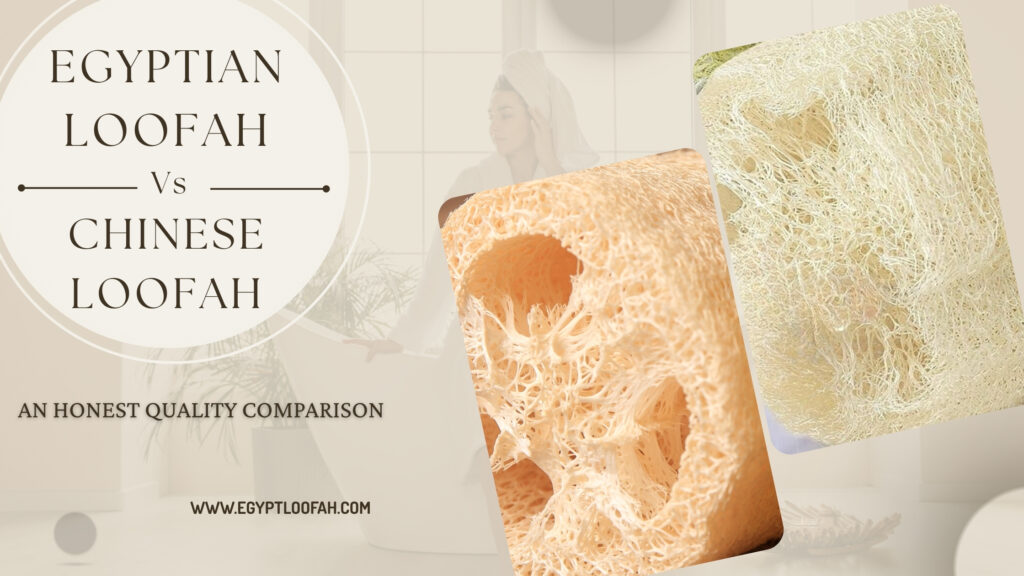
The Loofah You Choose Tells a Story About Where It Grew
That single fact makes the question of Egyptian loofah vs Chinese loofah one of the most practical comparisons anyone in this market can explore, whether you are a spa owner filling shelves, a distributor negotiating container loads, or a consumer standing in a store wondering which sponge is actually worth the price.
Both countries cultivate the Luffa aegyptiaca plant (sometimes called Luffa cylindrica), yet the end products can feel like they belong to entirely different categories. Climate, soil chemistry, harvesting traditions, and post-harvest processing all leave a fingerprint on every single fiber.
EGEXO has been exporting Egyptian loofah since 2015. By the end, you will understand exactly what separates these two origins and how to make a confident buying decision, whether you are ordering one loofah or ten thousand.
If you are a wholesale buyer looking for verified quality, you can request a quote from Egexo at any point. If you are shopping for personal use, browse the full collection here.
Why Origin Matters More Than Most People Think
When people compare Egyptian loofah vs Chinese loofah, the conversation usually starts and ends with price. That is a mistake. Origin determines fiber structure, and fiber structure determines performance. Understanding the agricultural context behind each product helps both buyers and consumers make decisions that hold up over time.
Climate and Soil Influence on Fiber Quality
Egypt’s Nile Delta and the Nile Delta regions offer a unique combination of intense sunlight, low humidity during the drying season, and mineral-rich alluvial soil. These conditions encourage the loofah gourd to develop a dense, tightly woven fiber matrix. The plant essentially works harder in this environment, producing thicker cell walls that result in a firmer, more resilient sponge.
China’s loofah cultivation is concentrated in provinces like Henan, Shandong, and Fujian, where the monsoon climate delivers higher rainfall and humidity. The abundant moisture tends to produce gourds that grow faster and larger, but with a looser, softer fiber network. This is not inherently bad. Softer loofahs serve certain market segments well. But for buyers who prioritize durability and exfoliating performance, the difference is measurable.
Harvesting Traditions and Timing
Egyptian loofah farmers, particularly those working with established exporters like Egexo, follow strict harvest-timing protocols. Gourds are left on the vine until full maturity, then dried naturally in the arid climate before processing. This patience yields a fiber that resists breakdown and maintains its shape through months of regular use. You can explore the full farm-to-export process here to see each stage in detail.
In many Chinese operations, faster turnover cycles mean gourds are sometimes harvested slightly earlier to meet volume demands. The resulting loofah can feel adequate at first but may lose structural integrity sooner, especially when exposed to repeated wetting and drying in a bathroom or spa setting.
Side-by-Side Quality Comparison: Egyptian vs Chinese Loofah
The following table draws on production data from Egyptian suppliers, trade inspection reports, and hands-on product testing.
| Quality Factor | Egyptian Loofah | Chinese Loofah |
|---|---|---|
| Fiber Density (fibers per sq cm) | 18 to 24 | 10 to 16 |
| Exfoliation Rating (1 to 10 scale) | 7 to 9 | 4 to 6 |
| Natural Color Consistency | High, uniform cream to tan | Moderate, variable yellow to brown |
| Typical Fiber Wall Thickness | 0.8 to 1.2 mm | 0.4 to 0.8 mm |
| Moisture Resistance | Strong, dries quickly in arid post-harvest | Moderate, may retain moisture longer |
| Post-Harvest Drying Method | Natural sun drying, low humidity | Mixed, often kiln-assisted |
This data tells a consistent story. Egyptian loofah generally outperforms on durability, texture uniformity, and cleanliness, making it the preferred choice for premium retail, spa, and hospitality markets. Chinese loofah competes strongly on volume availability and appeals to price-sensitive market segments.
For buyers evaluating these differences hands-on, ordering samples from Egexo is the fastest way to feel the difference before committing to a bulk purchase.
What Wholesale Buyers and Consumers Should Look For
Knowing the origin is only the first step. Whether you are inspecting a container shipment at port or squeezing a loofah at a farmers market, certain quality markers separate a premium product from a mediocre one. Here is a practical evaluation framework that works at any scale.
Quality Evaluation Checklist
| Evaluation Criteria | What to Look For | Why It Matters |
|---|---|---|
| Fiber Uniformity | Even texture across the entire surface, no thin patches or holes | Indicates full maturity at harvest and proper drying |
| Color Consistency | Natural cream to light tan without dark spots or heavy discoloration | Dark patches may signal mold exposure or premature harvesting |
| Structural Firmness | Sponge holds shape when squeezed and springs back | Dense fibers last longer and exfoliate more effectively |
| Seed Residue | No seeds or seed fragments trapped inside | Clean processing reflects quality control standards |
| Odor | Neutral, earthy, no musty or chemical smell | Mustiness indicates moisture damage, chemical smell suggests bleaching |
| Flexibility When Wet | Becomes pliable without falling apart or becoming mushy | Good fiber integrity allows repeated use in wet environments |
| Cut Edge Quality (for shaped products) | Clean, even cuts with no fraying | Professional manufacturing and finishing |
| Size Consistency Within Batch | Minimal variation in dimensions across units | Important for retail packaging and spa standardization |
This checklist applies equally whether you are a sourcing manager reviewing supplier samples or a consumer evaluating a product at a boutique store. The signs of quality are the same at every level.
Egexo maintains detailed quality standards documentation that covers these criteria and more, including testing protocols used for export shipments.
The Manufacturing Process: From Vine to Finished Product
Understanding how a loofah goes from a gourd on a vine to a finished product on a shelf reveals why certain origins produce consistently better results. The process also matters to consumers who care about sustainability and to buyers who need to evaluate supply chain reliability.
Egyptian Loofah Production Steps
| Stage | Process Description | Quality Impact |
|---|---|---|
| 2. Maturation on Vine | Gourds left until outer skin dries and turns brown naturally | Full maturity ensures maximum fiber strength |
| 3. Harvesting | Hand-picked at optimal dryness, sorted in field | Manual selection removes damaged gourds early |
| 4. Peeling | Outer skin removed by hand or light mechanical process | Reveals the inner fiber network without damage |
| 5. Seed Removal | Seeds shaken and washed out using water pressure | Clean interior improves hygiene and appearance |
| 8. Cutting and Shaping | Cut to specification: whole, sliced, shaped, or custom | Meets product requirements for retail or spa use |
| 10. Packaging and Export | Packed per buyer specs, export documentation prepared | Ready for international shipping with full traceability |
This ten-stage process reflects the standard at Egexo and similar established Egyptian producers. Each step builds on the previous one, and shortcuts at any stage affect the final product. When you compare this to operations where kiln drying replaces sun drying or where mechanical peeling damages fibers, the quality gap becomes clear.
For a visual walkthrough with real production photos, visit the farm to export page.
Practical Performance: What the Difference Feels Like in Daily Use
For consumers, the Egyptian loofah vs Chinese loofah comparison ultimately comes down to everyday experience. How does the sponge feel? Is it worth spending a bit more?
Shower and Bath Use
An Egyptian loofah in the shower provides a noticeably firmer exfoliation. The dense fibers create more surface contact per stroke, which means more effective removal of dead skin cells without needing to press hard. After soaking in warm water for 30 to 60 seconds, the sponge becomes pliable but retains its structure, an important balance for comfortable use.
A Chinese loofah often feels softer right out of the package, which some users prefer for sensitive skin. However, the softer fibers tend to compress and flatten faster with repeated use. Where an Egyptian loofah might maintain its lathering ability and texture for four months, a comparable Chinese product may need replacement after six to eight weeks.
Kitchen Use
Kitchen loofahs face harsher conditions than bath products: hot water, grease, food residue, and frequent wringing. Fiber density becomes even more important here. Egyptian loofah scrubbers hold up significantly better for dish cleaning and surface scrubbing, resisting the breakdown that turns a natural sponge into a limp rag.
Spa and Professional Settings
For spas, hotels, and wellness centers that use loofahs as part of their service offerings, the durability question carries direct financial weight. This is one reason why premium hospitality brands increasingly specify Egyptian origin in their procurement requirements.
Businesses serving the spa sector can find dedicated product options in the body loofah and raw loofah scrubber collections.
Sustainability and Environmental Considerations
Both Egyptian and Chinese loofahs are natural, biodegradable products, which gives them a massive environmental advantage over synthetic sponges and plastic mesh poufs. But the sustainability story has layers worth examining for eco-conscious consumers and buyers building green product lines.
Water Footprint and Farming Practices
Egyptian loofah farming in the Nile Valley benefits from centuries-old irrigation infrastructure. Many farms use flood irrigation from the Nile, requiring minimal groundwater extraction. The crop fits naturally into crop rotation cycles alongside cotton, sugarcane, and other traditional Egyptian crops, which supports soil health.
Chinese loofah farming varies widely by region and scale.
Carbon Footprint of Shipping
This is where geography matters. For European buyers, Egyptian loofah shipped through Mediterranean ports has a shorter transport distance than product from East Asia. For North American buyers on the East Coast, the difference is similar. West Coast North American buyers may find the shipping distance roughly equivalent. Including carbon footprint in sourcing decisions is becoming standard for brands that market sustainability, and origin selection plays directly into that calculation.
End-of-Life Biodegradability
Both origins produce fully compostable products. A natural loofah, regardless of origin, will break down in a home compost system within four to eight weeks. This positions natural loofah as one of the few truly zero-waste bath and kitchen products on the market, a selling point that resonates strongly with consumers and with retailers building eco-friendly product assortments.
Supplier Evaluation: How to Choose the Right Loofah Partner
For importers, distributors, and brand owners, the Egyptian loofah vs Chinese loofah comparison extends beyond the product itself into the reliability and capability of the supply chain behind it.
Supplier Selection Criteria
When evaluating any loofah supplier, regardless of origin, consider these factors in order of importance.
Consistency across shipments matters more than any single sample. Ask for references from long-term buyers and request test orders before signing volume contracts. A supplier with 25 or more years of operation, like Egexo, has the track record to demonstrate this consistency.
Communication and transparency separate professional export operations from opportunistic middlemen. Your supplier should be able to provide documentation on farming practices, processing methods, and quality control steps. Egexo’s quality standards page is an example of the transparency level you should expect.
Customization capability becomes important as your product line matures. Can the supplier produce custom sizes, shapes, and packaging? Do they offer private labeling? These services add significant value for brands looking to differentiate.
Certification readiness is non-negotiable for many retail and hospitality channels.
Capacity and lead time reliability protect your business from stockouts. Learn more about why sourcing professionals choose Egexo.
Egyptian Loofah vs Chinese Loofah: Strengths at a Glance
| Category | Egyptian Loofah Strengths | Chinese Loofah Strengths |
|---|---|---|
| Exfoliation | Firm, effective dead skin removal | Gentler, may suit sensitive skin |
| Price Point | Higher per unit, lower cost per use over time | Lower upfront per unit cost |
| Volume Availability | Moderate, seasonal harvest cycles | High, year-round production in many regions |
| Cosmetic Consistency | High uniformity in color and texture | More variation between batches |
| Best For Premium Markets | Yes, ideal for luxury retail and hospitality | Better suited for economy and mass market |
| Sustainability Credentials | Strong, natural farming and drying methods | Varies significantly by producer |
| Custom Manufacturing | Widely available from established exporters | Available but quality oversight may vary |
This table is not about declaring one origin universally better than the other. It is about matching the right product to the right application. For premium, performance-driven markets, Egyptian loofah consistently wins on the metrics that matter most. For price-driven bulk markets where durability is less critical, Chinese loofah fills a real need.
Expert Insight from EGEXO
One insight that comes up repeatedly in conversations with first-time buyers is this: the true cost of a loofah is not the price on the invoice. It is the price divided by the number of satisfied uses the end customer gets from it. When buyers factor in fewer customer complaints, fewer replacements, and higher perceived value at the retail shelf, the case for Egyptian origin becomes clear. If you are evaluating suppliers, start with samples. The difference is something you feel immediately. Samples are paid and the buyer pays shipping. The sample cost is credited to your first order of $1,000 or more, placed within 60 days. To discuss an order, request a quote from EGEXO.
Frequently Asked Questions
Q1: What is the main difference between Egyptian loofah and Chinese loofah?
A: The main difference between Egyptian loofah and Chinese loofah is fiber density. Egyptian loofahs typically have 18 to 24 fibers per square centimeter compared to 10 to 16 for Chinese loofahs.
Q2: Is Egyptian loofah worth the higher price for wholesale buyers?
A: Yes, for buyers targeting premium, spa, hospitality, or eco-conscious retail markets. Buyers also report fewer quality complaints and higher reorder rates from their customers. For detailed pricing on bulk orders, you can request a quote directly from Egexo.
Q4: What is the minimum order quantity for wholesale Egyptian loofah?
A: No minimum order on standard products. Private label from 1,000 units. Sample orders are available separately for quality evaluation before committing to bulk volumes.
Q5: Are Egyptian loofahs better for sensitive skin?
A: Egyptian loofahs offer firmer exfoliation, which is excellent for most skin types but may feel intense for very sensitive skin when used dry. Soaking an Egyptian loofah in warm water for 60 seconds softens the fibers considerably, making it comfortable for sensitive skin while still providing effective exfoliation. For the gentlest option, look for thinner-cut Egyptian loofah slices which offer a lighter touch.
Q6: How can I verify the origin of a loofah product?
A: Ask the supplier for certificates of origin, phytosanitary certificates, and export documentation that traces the product to its farming region. Reputable Egyptian exporters provide full traceability from farm to shipment. Physical indicators include dense, uniform fiber structure, consistent light cream color, and a clean neutral scent. Testing a verified Egyptian sample side by side with other origins is the most reliable method.
Q7: Can I get custom-branded Egyptian loofah for my business?
A: Yes. Egyptian suppliers like Egexo offer comprehensive private label and custom product design services. This includes custom sizing, shape cutting, packaging design, branded labels, and bundled product kits. These services allow spa owners, retailers, and online sellers to build unique loofah product lines backed by Egyptian quality without managing production themselves.
Q8: Is natural loofah more sustainable than synthetic sponges?
A: Natural loofah is significantly more sustainable. Egyptian loofah adds further sustainability advantages through natural sun drying, traditional farming methods, and shorter shipping routes to European markets.
Conclusion
The Egyptian loofah vs Chinese loofah comparison comes down to what you value most and what market you serve. For price-sensitive, high-volume, economy-tier applications, Chinese loofah fills a legitimate role.
The data supports what experienced buyers and long-time consumers already know through use: origin shapes quality in measurable, repeatable ways.
Key Takeaways:
- Consumers gain a longer-lasting, more effective, and more sustainable bath and kitchen product by choosing Egyptian origin
Ready to experience Egyptian loofah quality?
- For Wholesale Buyers: Request a quote or request samples
- Product catalog: Download our product catalog